

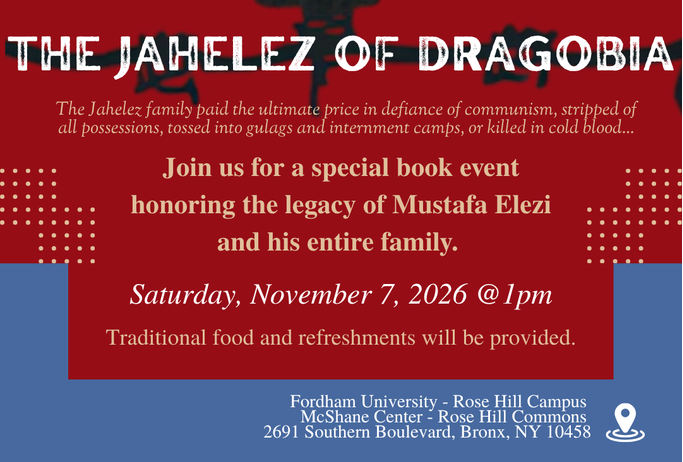
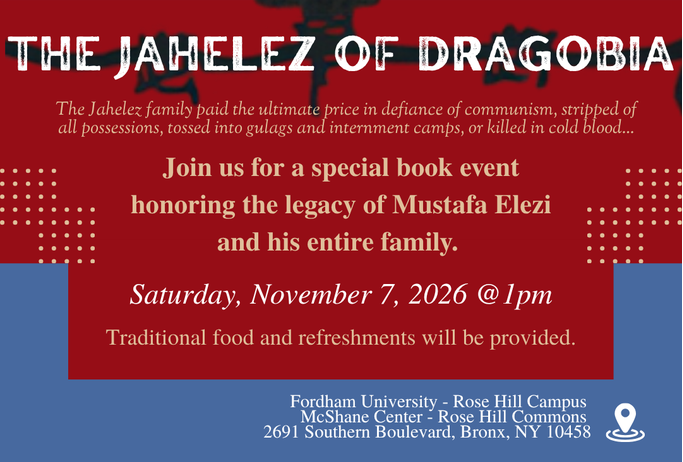
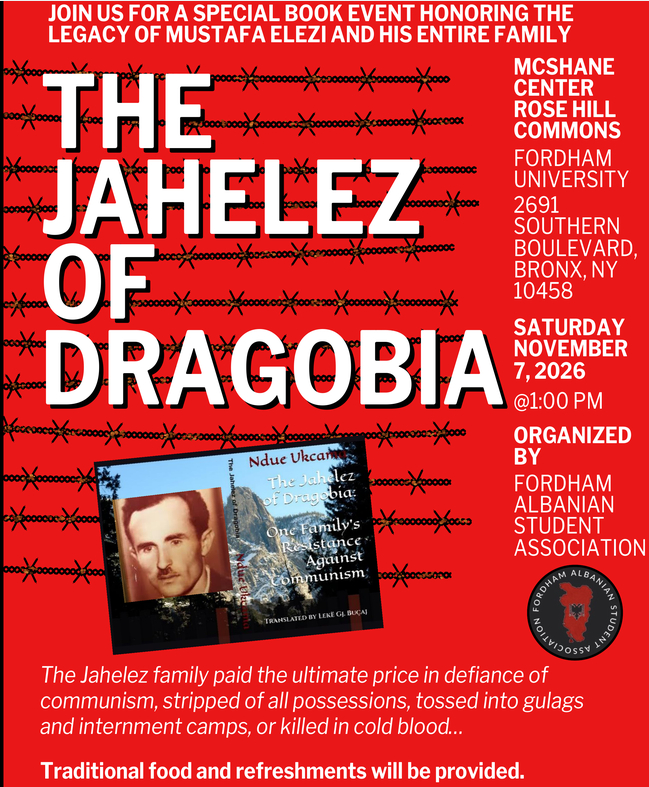
Albanian Student Association of Fordham University in New York event marks the English edition of The Jahelez of Dragobia
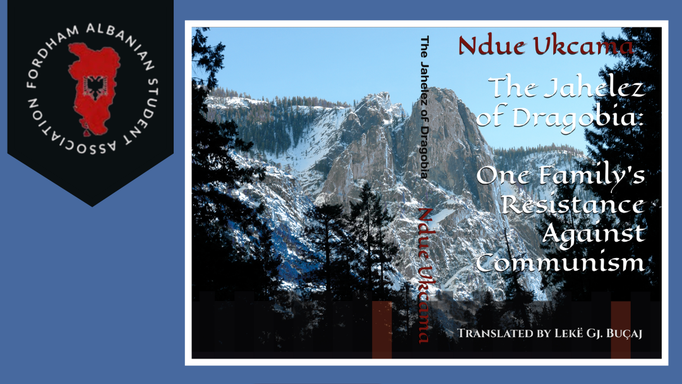
NEW YORK, Nov. 7, 2026. On Saturday afternoon, in a quiet room at Fordham University, the translator Lekë Buçaj walked a copy of a newly published book across the floor and placed it in the hands of Mergim Elezi. The book is the English edition of The Jahelez of Dragobia, the memoir of Mergim’s father, Mustaf Elezi. Buçaj said the gesture fulfilled an amanet, a sacred trust passed from one person to another, which he had carried for years.
The moment was the emotional center of an event organized by Fordham’s University Albanian Student Association (ASA) to examine the book and the history behind it. Association co-president Leona Gjevukaj opened the program with a greeting in Albanian, “Mirë se keni ardhur,” and told the audience the afternoon was meant to explore how communism shaped Albanian lives and families across generations. For students growing up between cultures, she said, such conversations help “preserve stories that deserve to be heard.” She thanked the association’s executive board and everyone who helped organize the event.
Gjevukaj then introduced the guest speaker, Dr. Mithat Gashi, as an Albanian American educator and community advocate whose work has connected education, scholarship, and service. She noted that he has served as principal of New World High School in the Bronx and has taught in Lehman College’s Department of Middle and High School Education. Gashi earned his doctorate at Fordham, she added, and brings a perspective as both an educator and an active member of the Albanian American community.
Gashi outlined the program and led the audience in standing for the national anthems of Albania and the United States. In his talk, “Preserving the Truth: The Jahelez of Dragobia and Historical Memory,” he described Dragobia, a mountain valley in northern Albania near the borders with Kosova and Montenegro, and the family memoir by Ndue Ukcama that follows the Jahelez over sixty-four years, from November 1944 to 2008. Mustaf Elezi arrived in the Bronx in 1968, Gashi noted, and lived there longer than anywhere else.
He also reminded the room that Fordham has long been part of the Albanian community, with many events held in its halls. He recalled meeting Ibrahim Rugova, the Kosova intellectual who later became its president, at Fordham in 1989, when Rugova came to speak at an event marking the 300th anniversary of Pjetër Bogdani.
Gashi, who escaped Albania in 1986, said the history is not distant for him. He pointed to the 1988 hanging of the poet Havzi Nela as a sign of how recent these events are. He asked the audience to consider what the regime tried to take from the family: their land, their contact with one another, their name, and their story. Had Mustaf Elezi not put his memoir on paper, Gashi said, these stories would have vanished.
“Who will tell the story?”
To make the point about memory and preservation, Gashi told a story from about fifteen years ago, when he worked with the photographer Norman Gershman, who documented how Albanians rescued Jews during World War II. The two visited the Kupferberg Holocaust Center at Queensborough Community College together. When Gashi asked how the center raised its funds, the answer from the director of the center was a line posted at the entrance, asking who will tell the story when they are all gone. Gashi lingered on this moment, and it shaped the rest of his remarks.
A promise passed between friends
Buçaj then explained how the book came into English. Mustaf Elezi, he said, had told his friend Zef Përndocaj that he wanted the story translated. Përndocaj raised it with Dr. Gjon Buçaj, Lekë’s father. Elezi died on October 1, 2018. After his death, Dr. Buçaj asked his son to take on the work.
Lekë had spent years as a translator and interpreter for federal government agencies, but he was busy, and the book was long. He accepted anyway. Dr. Buçaj died in 2022, and Lekë said the project then became something he was bound to finish, an amanet. He thanked his mother, Nikoleta, who sat in the audience, for always speaking to him in Albanian as he grew up. Without that, he suggested, he could not have done the work.
Then he called Mergim Elezi forward, handed him a copy of the book, and said that this fulfilled the amanet.
Family members also spoke. Among them were Mustaf Elezi’s eldest son, Mergim, and his daughter Sanije, who shared personal stories about her father’s first trip back to Albania. Sanije’s daughter, Syzana Vuçetaj, who holds a Ph.D. from New York University, also addressed the audience. Elezi’s other daughter, Shpresa, shared her emotions and memories in conversation following the program.
Voices from the page
Students and family members read from the book between remarks. Gjevukaj read the account of Mustaf Elezi’s arrest in August 1949. Ema Aliçkaj, a senior, gave her part of the reading of “February 19, 1957: Farewell!”, about his flight from Albania, to Mustaf Elezi’s granddaughters Tabitha and Victoria and their mother, Mergim’s wife. Art Lecaj, co-president of the Albanian Student Association, read “The Night of August 30, 1960,” and its aftermath, when fifteen families were interned. Andrra Kryeziu closed the readings with the family’s request from the epilogue: “Please, no longer say, ‘Oh, how the Jahelez have suffered,’ but ‘Oh, how they resisted.’”
Gashi then invited Prof. Kadri Brogi of Hunter College, CUNY, to offer reflections. Brogi encouraged the young people in the room to seek out activities like this one and to stay close to their history.
He also spoke about the falsification of history under communism. Schools taught that 28000 deshmorë, or martyrs, fell during World War II among the 27 brigades, he said, a claim he called a lie that makes no statistical sense. He added that every brigade commander was later executed or killed during the long years of the dictatorship. Gashi added that this included Mehmet Shehu, commander of the First Brigade, who later became prime minister and died in 1981 in circumstances the regime described as suicide.
A panel discussion followed among students, Brogi, and Gashi.
In closing, Gashi returned to the question from the Holocaust center and turned it into a call to action. He urged the students to ask questions at their own family tables, to write down what their parents and grandparents tell them before it is lost, and to read stories like this one aloud. Memory survives, he said, only when someone picks it up. The afternoon ended with questions from the audience, followed by refreshments and conversation.
The English edition of The Jahelez of Dragobia is available on Amazon.com.


 – For English click here



Sali Berisha – Komunisti I fundit ne perpjekjen finale per realizimin e Amaneteve te Diktatorit Komunist Enver Hoxha, Doktrines Antikombetare te Partise se Punes dhe Qellimeve te Perjetshme lakmitare te Fqinjeve dhe Fuqive Antishqiptare Gjakatare!, pasi realizoi;
– Reformen Agrare ne vend te kthimit te Pronave, ne aplikimin e ligjit Komunist – 7501. Prona, dhunshem e rrembyer dhe e vjedhur dhe sot e kesaj dite eshte e rrembyer dhe e vjedhur vetem ne Shqiperi!
– mosgjetjen e Perjetshme te Eshtrave te viktimave politike te Enverit dhe Diktatues, duke mos bere Kurre nje ligj per angazhimin e Shtetit ne gjetjen e tyre, deri ne vdeklen fizike te personave qe kishin dijeni per to!
– jo vetem mosinkludimin dinjitoz sipas nje Plani Kombetar te Persekutuarve Politike por Shfarosjen perfundimtare te tyre nga cdo perfaqsim lidershipi ne nivel Shteteror app Rajonal, deri ne Shtypjen e Dhunshme Puniste te strukturave dhe shoqatave te tyre. Duke I dhene te Persekutuarve Politike dhe pasardhesve te Patrioteve dhe Burrave te medhenj te Kombit vetem nje alternative;-Braktisjen e Vendit, ikjen pa nam e pa nishan dhe Harresen e tyre! Enveri ju vrau, ju burgosi, ju internoi dhe ju dogji shpirtin she ju Persekutoi, Sali Berisha e permbushi Amanetin t’ju zhdukte perjete nga faqja e dheut Shqiptar!
– Favorizimin e Komunisteve dhe sherbetoreve te Sigurimit te Shtetit ne hajduterine komuniste ne Privatizime
– Ringjalljen dhe konsolidimin perhershem te parimit Stalinist – Populli voton, Partia (vendos vjedh) numeron!,, me zghedhjet e dhunshme te vitit 1996! Sot e kesaj dite, ne mes te Europes, vetem ne Shqiperi nuk ka zgjedhje Demokratike!
– (ashtu si “babë” Enveri qe shtypte me gjek Revoltat Popullore Antikomuniste, . )
… urdherimin e avioneve, tankeve, armatosjen e nje pjese te shqiptareve per te vrare shqiptare ne vitin gjakatar 1997!
– se fundi, imponimin e vendimeve politike Antidemokrative, Antishqiptare, Antiamerikane dhe Antievropiane, kunder perpjekjeve per nxjerrjen e Demokracise dhe Shtetit Ligjor nga kthetrat Postdiktatoriale dhe Korruptive
Pasi sanksionoi Fitoren e Postkomunisteve
– mbi Pronen,
– mbi te Persekutuarit Politike,
– mbi moslindjen e Demokracise Perendimore dhe Shtetit Ligjor per Shqiptaret
Pasi sanksionoi fitoren e Korrupsionit Postdiktatorial ne Zhvajtjen, Gjymtimin dhe Vjedhjen e Shqiptareve dhe Shqiperise, qe vazhdone te zbatohet me eger se kurre dhe sot e kesaj dite nga Kelyshe te tjere te Komunisteve,
…tani eshte duke dhene shpirt ne perpjekjen Finale te permbushjes se Amanetit me te madh ne Testamentin e Enverit – mobilizimin e shqiptareve kunder Rrezikut Anglo-Amerikan per Shqiperine!
…para se te jape frymen e fundit te Komunistit!…ne sherbim te Postdiktatures!
Ne Shqiperi, si Haxhi Qamili qe kerkonte Baben, ne marrezine e vet, ka marre me vete per te fituar luften, ulerimat e te Korruptuarve dhe sfurqet e injoranteve!, ne Halenë-Foltore te 5 Dhjet-orit do qe te marre me vete Shqiptaret e Çpuar, Intelektualisht te Çale dhe menderisht te Marrë!
5 Dhjetori shenon kulmin dhe fundin e Turpit Kombetar te Betimit Komunist e Enverist te Sali Berishes!…por per shqiptaret pjesmarres do shenoje kulmin e Marrezise Shqiptare dhe fillimin e Turpit te Tyre!
Shqiptaro-Amerikani
Arjan Kokoshi
Sali Berisha eshte i vetmi patriot qe ka shqiperia ne politike te gjithe te tjeret jane fuksa dhe tradhtare te kombit. Te gjithe te tjeret jane fuksa dhe bashkeponetore me terroristin me te madh te botes George Soros. Sa per Sali Berishen komunist ti rruani trapin.Komunista kane qene i gjithe populli shqiptar se bashku me ty dhe familjen tende z komentues prandaj mos fol per te shkuaren por fol per te ardhmen. Sali berisha nuk eshte e ardhmja por ai eshte duke i dale perballe terroristit George Soros por edhe bashkpunetoreve te tij dhe duke i hapur rruge te rinjeve qe te vazhdojne rrugen e tij ne mbrojtje te njerezve te lire e konservatore ne pertine Demokratike te shqiperise. Edi Rama bashke me Lulzim Bashen ja kane shit vendin Sorosit dhe qe 80% e shqiptareve nuk e kane idene se kush eshte Soros. Sultan brekushja Rama e paraqet Soros si mik te shqiptareve dhe si businessman. Ai nuk i tregon shqiptareve qe ne shume vende te botes ai eshte i padeshiruar dhe madje i kerkuar per krime. P.sh Malaysia ka pas vendosur 10 million dollar ne koken e tij apo ne vitet 70 theu banken e Anglise, presidenti i Philippines i tha Sorosit qe po fute kemben ketu do ti pres te dyja kurse ky tradhtari i kombit tone i thote popullit shqiptar se ky eshte mik i shqiptareve a kuptoni o popull!.