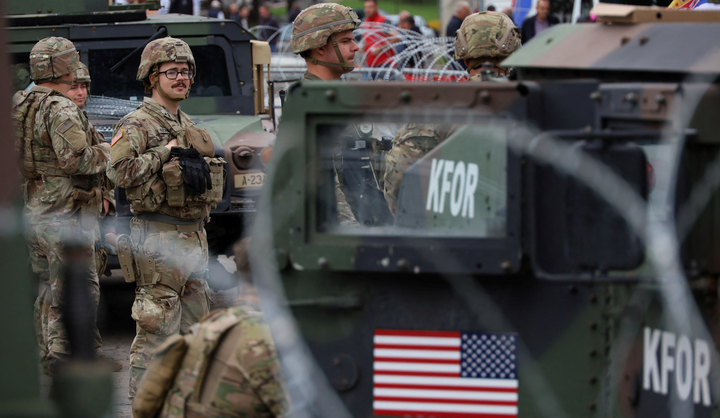
Recent claims published by Politico regarding a potential reduction of the United States’ presence in NATO missions, including KFOR in Kosovo, represent a clear case of the intersection between partial media reporting and narratives capable of generating destabilizing effects on public perception. Based on anonymous sources and speculative interpretations, such reporting constructs a perceived reality that does not correspond to factual developments on the ground or at the institutional level.
1. Official positions and lack of factual basis At the institutional level, claims regarding a withdrawal have been explicitly denied by key actors, including the Pentagoni, NATO structures, and U.S. European Command. Furthermore, the KFOR Commander, Ozkan Ulutaş, has confirmed that there are no plans for significant changes in the composition of forces in Kosovo. From a policy analysis perspective, the absence of formal decisions, consultative processes within NATO, and coordinated strategic signals constitutes sufficient evidence that such claims lack a factual foundation. Any reconfiguration of U.S. military presence in a strategically sensitive region such as the Western Balkans would necessarily involve transparent communication and extensive coordination with allies.
2. Psychological aggression and the function of disinformation From a theoretical standpoint, these narratives represent a form of “psychological aggression,” wherein information is used to generate insecurity, undermine trust in security institutions, and influence public and political behavior. Within the framework of hybrid warfare, disinformation serves as a tool to achieve strategic objectives without the direct use of military force. Narratives about U.S. withdrawal are particularly effective in regions such as Kosova, where the American presence is perceived as a primary security guarantee. The dissemination of such claims aims to create social uncertainty, increase interethnic tensions, and weaken confidence in Euro-Atlantic alliances.
3. Hybrid propaganda of Serbia and Rusia
A key dimension of this phenomenon is the role of hybrid propaganda by state and semi-state actors, particularly Serbia and Rusia. These actors employ a wide range of instruments to influence the information environment in the Western Balkans:
• Pro-government media and online platforms that amplify anti-NATO and anti-U.S. narratives
• Social media and coordinated information operations to spread false or distorted content
• Political and diplomatic discourse portraying NATO as a destabilizing force
• Conspiracy theories regarding the “abandonment” of the region by the West Within this framework, narratives about the withdrawal of U.S. troops serve to reinforce perceptions that NATO is weakening and that regional states should reconsider their strategic orientation.
4. The role of other actors and influence networks In addition to Rusia, Kina also contributes to shaping alternative narratives to the Euro-Atlantic order, primarily through economic and technological influence. At the regional level, various political and media actors may act as amplifiers of these narratives, whether due to ideological alignment or short-term political interests. This creates a complex information ecosystem in which the boundaries between reporting, opinion, and propaganda become blurred, making it increasingly difficult for the public to distinguish verified information from disinformation.
5. Misinterpretation of U.S. policy Another important element is the misinterpretation of the policies of Donald Trump. Calls for increased defense spending by European allies have been selectively used to construct false narratives about a U.S. withdrawal from Europe. In reality, these policies aim to strengthen the collective capabilities of the alliance rather than reduce U.S. engagement in strategic regions. Selective interpretation of such positions constitutes a core mechanism in the construction of disinformation.
6. Implications for regional security The presence of the United States in Kosovo through KFOR remains a key pillar of regional stability.
It contributes to:
• preventing conflict escalation
• maintaining a stable security balance
• supporting local security institutions Any significant reduction of this presence would carry major geopolitical implications, potentially creating space for rival actors and increasing regional uncertainty. However, the absence of concrete indicators for such a change confirms that these scenarios remain hypothetical rather than real.
7. Conclusion
In conclusion, claims regarding the withdrawal of U.S. troops from Kosovo are unfounded and constitute part of a broader campaign of disinformation and psychological aggression. They are constructed through a combination of partial reporting, political misinterpretation, and amplification by hybrid propaganda networks, particularly linked to Serbia and Rusia. Official positions from the Pentagoni, NATO, and KFOR leadership confirm the استمرار (continuity) of U.S. engagement in Kosovo and the Western Balkans. As such, these narratives should be treated as disinformation and analyzed within the broader context of efforts to influence regional stability and strategic orientation.
Footnotes
[1] Official statements from the Pentagoni, NATO, and KFOR leadership confirming no changes in military presence. [2] Academic literature on hybrid warfare and psychological operations in contemporary security studies. [3] Policy discourse of Donald Trump on burden-sharing within NATO. [4] Studies on the influence of Rusia and Serbia in the Western Balkans information space. [5] Analyses of the strategic role of KFOR and implications of potential force reductions.
The Land of Leka; 20.03.2026

 “Mos u largo nga familja”, amaneti i Abaz Kupit më 1944 për djalin para arratisjes! Dy arrestimet e Fatbardh Kupit
 “Jam i dehur nga urrejtja”, dëshmia e Mehmet Shehut për vrasjen e 80 nacionalistëve! Masakra në Lushnje më 1943
 YLLI MEÇAJ I VLORËS – ARTIST KOMBËTAR SHUMËPLANËSH- Nga Albert HABAZAJ
 NGATËRRESË NË TRENIN BALLSH-TIRANË-Tregim nga Shkëlqim HAJNO
 PREJ 800 JAVËSH ME GAZETËN LETRARE DHE KULTURORE “NACIONAL” Nga dr. Mujë BUÇPAPAJ
 KJO ËSHTË E SOTME- Poezi nga PABLO NERUDA – Shqipëroi: ELIDA BUÇPAPAJ
 Ka reaguar fotoreporteri Felix Bilani që u lëndua me spray nga policia: Është i ndaluar me konventa përdorimi i spray-it të ariut!
 JUSUF BUXHOVI: JU TREGOJ 80 VITE JETË DHE 60 VJET KRIJIMTARI- Intervistoi: Dr. Mujë Buçpapaj
 …FANTAZI ME GJALLESA – Prozë nga RUZHDI GOLE
 Irani mbyll sërish Ngushticën e Hormuzit
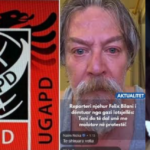 UGSHPD: Apel NATO-s, BE-së dhe organizmave të gazetarëve IFJ, RSF, EFJ etj të ndikojnë që në Shqipëri të ndalet dhuna e egër policore kundër opozitës e gazetarëve
 Kosovë- Pasuria e zyrtarëve publikë: Kush do ta verifikojë dhe a ka rrezik për ndikim politik?