1. Historical and Geopolitical Context The border area between Kosovo and Serbia, and military tension.
Following the Kosovo War and Kosovo’s declaration of independence in 2008, any military activity near the border is perceived as a potential provocation, increasing local communities’ concerns.[1]
Strategic villages such as Karaçevë, Breznicë, and Muhoc are directly affected by ongoing tensions, and the presence of Serbian forces in these areas generates anxiety and insecurity among residents.[2]
2. Serbian Military Exercises and Community Impact
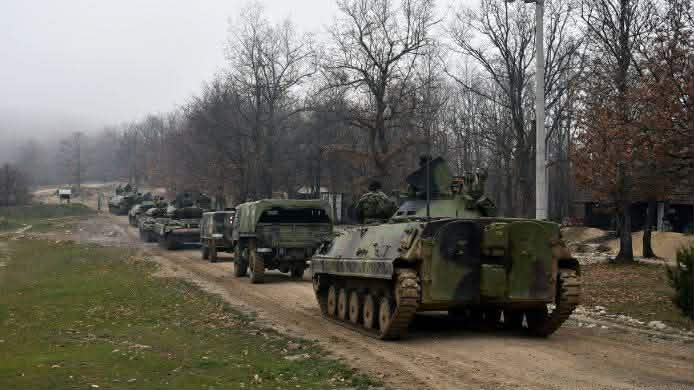
The military exercises conducted on March 18, 2026, near the border villages are not merely routine maneuvers. They function as a demonstration of power and psychological pressure on Kosovo and the residents of border areas.[3]
Key effects include:
• Psychological pressure and fear among residents.
• Disruption of daily and economic activities, hindering mobility and social life.
• Political and strategic signaling, directed at Kosovo (capacity demonstration), the international community (testing reactions), and Serbian public opinion (political legitimization and mobilization).
Critical analysis:
Such activities act as destabilizing instruments, increasing the potential for border incidents and ethnic tension escalation.
3. Russian Hybrid Policies
The 2026 report by USIC highlights Russia’s use of hybrid policies to increase tensions between Kosovo and Serbia and maintain influence in the Western Balkans.[4]
Russia employs various methods, including:
• State-sponsored non-governmental organizations for propaganda and ethnic division.
• Narratives portraying Serbs as victims and promoting connections with Moscow.
• Undermining confidence in NATO and the European Union.
Critical implication:
The interaction of Russian hybrid policies with Serbian military exercises intensifies the perceived threat, making the border environment more dangerous and potentially escalatory.
4. Serbia’s Armament Modernization and Supplies
4.1 Domestic Production
Serbia has heavily invested in its domestic defense industry, including facilities such as “Milan Blagojević.”
According to Aleksandar Vučić, domestic production and arms exports are increasing, while the Serbian Armed Forces are modernizing through digital technology and artificial intelligence.[5]
4.2 External Supplies In addition to domestic production, Serbia acquires complex systems from China, Turkey, and other countries, complementing its arsenal and enhancing defensive and offensive capabilities. These imports also serve as political and strategic signals to the region and the international community.[6]
4.3 Regional Impact
The combination of domestic production and external supplies positions Serbia as a strong regional actor, increasing pressure on Kosovo and signaling readiness for potential use of force in escalation scenarios.[7]
5. Impact on Citizens Residents of border areas face:
• Ongoing insecurity and tension.
• Disruption of daily and economic activities.
• Feelings of fear and threat to life and property.
This psychological pressure results from the combined effect of Serbian military exercises, Russian hybrid policies, and advanced armament supplies, creating a hazardous and destabilizing environment.[8]
6. Critical Analysis
1. Serbia – uses exercises, modernization, and external supplies as instruments of power demonstration and pressure on Kosovo.
2. Russia – employs hybrid policies to exploit divisions and undermine regional stability.
3. Local citizens – are direct victims of psychological pressure and insecurity.
4. Regional stability – is threatened by the interaction of military forces, hybrid policies, and advanced arms supplies, increasing the risk of border incidents and ethnic tension.
Critical conclusion:
The combination of Serbian exercises, Russian hybrid policies, and armament modernization, including external supplies, creates a strategically tense environment where citizens experience deep insecurity and regional stability remains fragile.
7. Recommendations
• Continuous international monitoring of military activities and arms supplies.
• Strong dialogue and de-escalation mechanisms between Kosovo and Serbia.
• Protection and information for citizens in border areas.
• Coordination with NATO and the EU to prevent escalation and neutralize the destabilizing influence of Russian hybrid policies.
Footnotes
[1] Judah, Tim. Kosovo: What Everyone Needs to Know. Oxford University Press, 2019. [2] Hyseni, Alban. Statement on Military Exercises Near the Border, Municipality of Gjilan, 18 March 2026. [3] Balkan Insight. “Serbia Military Drills Near Kosovo Border Raise Tensions,” 18 March 2026. [4] USIC. Worldwide Threat Assessment 2026: Russia’s Influence in the Western Balkans. Washington, D.C., 2026. [5] Vučić, Aleksandar. Statement on Modernization and Domestic Arms Production, 2026. [6] SIPRI Arms Transfers Database. Serbia Arms Imports Overview 2022–2025. Stockholm, 2025. [7] International Institute for Strategic Studies (IISS). The Military Balance 2026. London, 2026. [8] UNDP Kosovo. Human Security and Community Perceptions in Border Areas, Pristina, 2025.
The Land of Leka; 18.03.2026
 “Mos u largo nga familja”, amaneti i Abaz Kupit më 1944 për djalin para arratisjes! Dy arrestimet e Fatbardh Kupit
 “Jam i dehur nga urrejtja”, dëshmia e Mehmet Shehut për vrasjen e 80 nacionalistëve! Masakra në Lushnje më 1943
 YLLI MEÇAJ I VLORËS – ARTIST KOMBËTAR SHUMËPLANËSH- Nga Albert HABAZAJ
 NGATËRRESË NË TRENIN BALLSH-TIRANË-Tregim nga Shkëlqim HAJNO
 PREJ 800 JAVËSH ME GAZETËN LETRARE DHE KULTURORE “NACIONAL” Nga dr. Mujë BUÇPAPAJ
 KJO ËSHTË E SOTME- Poezi nga PABLO NERUDA – Shqipëroi: ELIDA BUÇPAPAJ
 Ka reaguar fotoreporteri Felix Bilani që u lëndua me spray nga policia: Është i ndaluar me konventa përdorimi i spray-it të ariut!
 JUSUF BUXHOVI: JU TREGOJ 80 VITE JETË DHE 60 VJET KRIJIMTARI- Intervistoi: Dr. Mujë Buçpapaj
 …FANTAZI ME GJALLESA – Prozë nga RUZHDI GOLE
 Irani mbyll sërish Ngushticën e Hormuzit
 UGSHPD: Apel NATO-s, BE-së dhe organizmave të gazetarëve IFJ, RSF, EFJ etj të ndikojnë që në Shqipëri të ndalet dhuna e egër policore kundër opozitës e gazetarëve
 Kosovë- Pasuria e zyrtarëve publikë: Kush do ta verifikojë dhe a ka rrezik për ndikim politik?