Kosovo’s position in the contemporary European security architecture, starting from George Washington’s premise: “To be prepared for war is one of the most effective means of preserving peace.”¹
Using a theoretical framework that combines structural realism and constructivism, demonstrating that Kosovo’s stability and sovereignty are primarily protected by domestic institutions and law, while international support is used only as an additional protective layer in cases of real threats.²
This case illustrates the concept of “protected and consolidated sovereignty,” where domestic power, respect for the rule of law, and readiness to confront real challenges serve as the primary means of preserving peace and sovereignty, relying on George Washington’s principle.³
1. Introduction
George Washington’s statement emphasizes a logic that is valid for Kosovo: “the preservation of peace requires real capabilities and strong domestic institutions.”⁴
In Kosovo’s context, sovereignty is primarily protected through: 1. Firm and well-organized military deterrence by domestic institutions; 2. Legitimacy and the rule of law; 3. International support as a supplement, not as the principal factor.⁵ The central question is: **How can a state with partial recognition consolidate its sovereignty by relying primarily on domestic law and institutions?**⁶ The thesis is that the protection of sovereignty cannot be explained by a single paradigm; it results from the interaction between: • Structural realism (deterrence)⁷ • Constructivism (identity and normative narrative)⁸
2. Theoretical Framework
2.1 Structural Realism According to Waltz, states seek survival in an anarchic international system.⁹ In Kosovo, deterrence and domestic military defense represent the primary axis of sovereignty.¹⁰ 2.2 Constructivism and Domestic Legitimacy Constructivists argue that interests are shaped by identity and norms.¹¹ In Kosovo, domestic law and institutions form the foundation of legitimacy and the consolidation of sovereignty. The supportive international narrative only reinforces this foundation.¹²
3. Protected and Consolidated Sovereignty
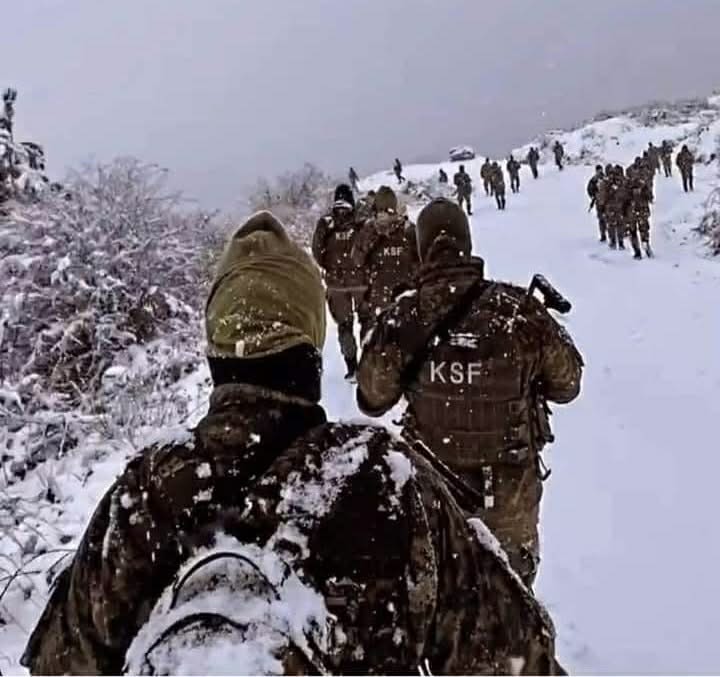
This article proposes the concept of “protected and consolidated sovereignty,” where a state: • Has strong institutions and law;¹³ • Exercises domestic capabilities for defense and security;¹⁴ • Benefits from international support only as an additional factor in emergency cases.¹⁵ Kosovo is the primary example of this model. The state and domestic law are the main factors, while KFOR and Western partners act as support in cases of real challenges.¹⁶
4. Discussion:
The Power of Law and Domestic Institutions Kosovo’s case demonstrates that sovereignty is best preserved when a country possesses: • Strong institutions and law, • Domestic defense capacities, • International support only when threats exceed domestic capabilities. This model emphasizes the importance of domestic independence and state strength in preserving peace.¹⁷
5. Conclusion
George Washington’s principle remains a guiding reference: preparation for real challenges is the key to preserving peace. In Kosovo, this translates into protected and consolidated sovereignty, where domestic institutions and laws hold primary priority. Meanwhile, international support functions as an additional protective layer in emergency cases.¹⁸
Footnotes: 1. George Washington, Maxims of Washington (Washington, D.C.: Library of Congress, 1790), cited in John P. Roche, The Founding Fathers: A Reform Caucus in Action (New York: Harper & Row, 1969), 112. 2. Waltz, Kenneth N., Theory of International Politics (New York: McGraw-Hill, 1979), 88–92. 3. Finnemore, Martha, and Kathryn Sikkink, International Norm Dynamics and Political Change (Cambridge: Cambridge University Press, 1998), 34–38. 4. Morgenthau, Hans J., Politics Among Nations, 7th ed. (New York: McGraw-Hill, 2005), 150–153. 5. Keohane, Robert O., After Hegemony (Princeton: Princeton University Press, 1984), 72–75. 6. Wendt, Alexander, Social Theory of International Politics (Cambridge: Cambridge University Press, 1999), 227–230. 7. UNSCR 1244, United Nations Security Council, 10 June 1999. 8. NATO, KFOR Mandate Reports, 1999–2019. 9. Moravcsik, Andrew, The Choice for Europe (Ithaca: Cornell University Press, 1998), 142–145. 10. Bieber, Florian, Understanding the War in Kosovo (London: Routledge, 2002), 210–215. 11. Judah, Tim, Kosovo: What Everyone Needs to Know (Oxford: Oxford University Press, 2008), 56–61. 12. Subotić, Jelena, Hijacked Justice (Ithaca: Cornell University Press, 2009), 10–12. 13. UNSCR 1244, United Nations Security Council, 10 June 1999. 14. NATO, KFOR Mandate Reports, 1999–2019. 15. U.S. Department of State, Country Reports on Kosovo, 2021. 16. Waltz, Theory of International Politics, 88–92. 17. Mearsheimer, John J., The Tragedy of Great Power Politics (New York: W.W. Norton & Company, 2001), 330–335. 18. Washington, Maxims of Washington, 112. The Land of Leka;23.02.2026

 KARAFILAT QË PËRQAFOJNË “KARIATIDET ”… Kujtime DR. EDUARD A. SKUFI
 Urime për postin e Presidentes, Justinë, çika shtatselvi e Simon Shirokës! Nga Çun Lajçi
 SKIFTER NË SHKREPA- Nga ARIF EJUPI
 KUR RIVALITETI POLITIK I LË VEND INTERESIT TË PËRGJITHSHËM- Nga ARIF EJUPI
 Prokuroria e akuzon Thaçin se ka gënjyer për historinë e UÇK-së – Thaçi duket se u kundërgodit nga intrigat e tij Nga Idriz Morina
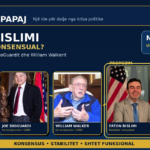 Albin Kurti & opozita duhet të bien dakord për Faton Bislimin, kandidatin për president konsensual propozuar nga kongresmeni JoeDioGuardi & ambasadori Walker Nga Elida Buçpapaj
 BIRN: Shqipëria, e papërgatitur për një ndryshim të rregullave të lojës nga BE
 Lisat nuk ikën- Poezi të reja nga Ismet TAHIRAJ
 Kamberi i përgjigjet Vuçiqit: “Nuk kuptoj çfarë po të shqetëson nga angazhimi im për shqiptarët”
 Shqipëria në planin rajonal për rikthimin e pyjeve, në fokus Alpet dhe pellgu i Drinit
 Kendi i humorit: I kërkon partnerit të bëjnë përsëri dashuri
 U miratua me 85 vota pro ndarja e re administrative, Shqipëria me 15 bashki më pak, si do funksionojnë! Ekspertët skeptikë: Nuk garanton shërbime për qytetarët