History must be defended with documents, sovereignty through diplomacy, and rights through law.
A Historical, Political, Diplomatic and Legal Analysis of the Statements of the Greek President, the “Northern Epirus” Claims and the Unresolved Albanian-Greek Issues
From the History of Borders to International Responsibility: Protecting Sovereignty, Historical Rights and Documentary Truth
PREFACE
Albanian-Greek relations cannot be built upon the denial of history, the relativisation of the rights of populations, or the one-sided use of the past for political purposes. The two peoples share a long history of coexistence, relations, conflicts and cultural interactions. They have common interests in regional security, European integration and economic development. For precisely this reason, unresolved issues must be addressed responsibly, on the basis of documentation and mutual respect.
The immediate impetus for this analysis was also the statement made by the President of the Republic of Greece, Konstantinos Tasoulas, on 28 October 2026 in Thessaloniki, during the commemoration of the 86th anniversary of Greece’s rejection of the Italian ultimatum of 1940.
In his statement, the Greek president used the expression “the epic of Northern Epirus”, referring to the Greek military campaign of 1940–1941.[1]
It must be clarified from the outset that the use of this expression in a commemorative speech does not, in itself, constitute a legal act or a formal demand to alter the Albanian-Greek border. Nevertheless, when a term with a well-known political and irredentist history is used by the head of the Greek state, it acquires political and diplomatic weight that goes beyond an ordinary commemorative expression.
It is therefore legitimate to request clarification regarding the meaning that Greek institutions attach to this term, particularly given that Albania and Greece are both members of NATO and have undertaken to respect the principles of sovereignty, territorial integrity and good-neighbourly relations.
This analysis does not seek to advance counter-territorial claims or encourage hostility between the two peoples. Its purpose is to examine historical and legal documentation, identify unresolved issues and propose a constructive position for Albanian diplomacy.
I. THE GREEK PRESIDENT’S STATEMENT AND THE PROBLEM OF POLITICAL TERMINOLOGY
President Konstantinos Tasoulas’s statement deserves analysis not only in the context of commemorating the Second World War, but also within the historical context of Albanian-Greek relations.
On 28 October 1940, Fascist Italy attacked Greece, using Albanian territory, which it had occupied on 7 April 1939. The Greek army repelled the Italian offensive and subsequently entered Albanian territory occupied by Italy.
This military campaign constitutes an important chapter in Greek history. The sacrifices of Greek soldiers and civilians during the struggle against fascist aggression deserve to be remembered.
However, there is a distinction between commemorating a military campaign and using a designation that carries territorial implications.
The term “Northern Epirus” is not merely a neutral geographical name. In Greek political history, it has also been used by nationalist circles to articulate claims over territories in southern Albania.
This is precisely where the diplomatic problem arises.
If the Greek president intended only to commemorate the military operations of 1940–1941, it would have been more appropriate to use neutral historical terminology, such as “the Greek campaign on the Albanian front” or “the Greco-Italian War”.
The use of the term “Northern Epirus” requires clarification because it may be interpreted as a continuation of a political tradition that has treated Albanian territory as an area subject to Greek historical claims.
A presidential statement should not automatically be interpreted as official territorial policy. However, neither should it be regarded as insignificant, particularly when it comes from the highest representative institution of the state.
Respect for the sovereignty of a neighbouring state also requires responsibility in the use of historical terminology.
Albania’s government therefore has the right to request diplomatic clarification without turning this issue into a conflict with the Greek people.
II. EPIRUS IN HISTORY: GEOGRAPHY, POLITICAL ENTITIES AND ETHNIC AFFILIATION
1. Ancient Epirus cannot be mechanically identified with modern borders
To understand the problem surrounding the term “Northern Epirus”, we must return to the history of the name Epirus.
In antiquity, Epirus was a historical and geographical region in the western part of the Balkans, with boundaries that varied according to different periods and ancient authors.
Several tribal communities lived in this territory, including the Molossians, Thesprotians and Chaonians. During certain periods, they united within political structures and established an Epirote kingdom, which experienced significant development during the reign of Pyrrhus of Epirus.
Therefore, Epirus was neither an entity with unchanging borders throughout antiquity nor a territorial unit that can be directly equated with a modern state.
Isuf B. Bajrami, in his study “Epirus and the Ethnic Affiliation of the Epirotes”, published on 24 October 2007 in the newspaper Zemra Shqiptare, addresses precisely the history of this designation and the debates surrounding the identity of the Epirote populations.[2]
The author emphasises that the name Epirus initially had a geographical meaning and that its territorial extent varied during different historical periods.
Nevertheless, the ethnic affiliation of the Epirote tribes remains a complex issue in ancient historiography. It cannot be resolved solely through the etymology of names or national interpretations of ancient sources.
For this reason, the accounts of Thucydides, Strabo and other authors must be compared with archaeological, linguistic and historical evidence.[3]
2. Roman Epirus: Epirus Vetus and Epirus Nova
An important historical fact is the administrative division of Epirus during the Roman period.
In the Roman provincial organisation, the following designations were used:
Epirus Vetus – Old Epirus.
Epirus Nova – New Epirus.
These were administrative units of the Roman Empire and must not be confused with national divisions or the state borders of modern times.[4]
This is important because ancient names and Roman administrative designations cannot be used as legal arguments to support territorial claims in the nineteenth, twentieth or twenty-first centuries.
3. Epirus during the Middle Ages and the use of Albanian designations
During the Middle Ages, the region of Epirus underwent numerous political and administrative changes. Various historical sources contain designations such as Albania, Epirus, Arbanon and other regional names.
In some Western sources, parts of Albania were also known by the designation Albania Inferior, or Lower Albania.
Nevertheless, it should not be claimed that this designation represented the single official name of all Epirus or that every medieval map used it in the same way.
What can be stated with certainty is that geographical and political designations changed depending on the period and the author.
Therefore, the use of an ancient name to support modern territorial claims does not constitute a legal argument.
4. Epirus and Albanian identity
One of the main problems in the contemporary debate is the attempt to present the history of Epirus as the exclusive property of a single national identity.
The history of this region is considerably more complex.
Different populations have lived and coexisted there, including Albanians, Greeks, Vlachs and other communities.
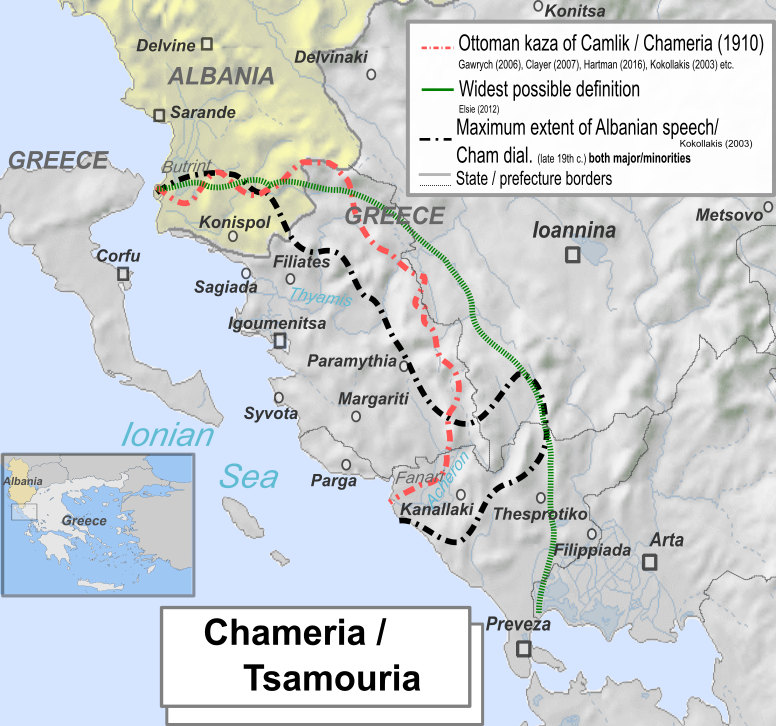
Albanians have a historically documented presence in many areas of historical Epirus, particularly in the region of Chameria and the surrounding districts.
This presence must not be denied, but neither should it be transformed into a claim that all populations and all historical periods had the same ethnic composition.
History cannot be monopolised by any state, and no people has the right to use the past as a legal title to territories that today belong to a sovereign state.
III. “NORTHERN EPIRUS”: FROM GEOGRAPHICAL DESIGNATION TO POLITICAL USAGE
The term “Northern Epirus” must be examined within the context of Balkan nationalism in the nineteenth and twentieth centuries.
Following the establishment of the modern Greek state and its territorial expansion, Greek political and nationalist circles began articulating claims over territories beyond Greece’s then-existing borders, relying on historical, religious and cultural arguments.
In this context, the ideology of Megali Idea also developed, seeking the expansion of the Greek state and the incorporation of territories considered by Greek nationalism to be part of its historical sphere.
The term “Northern Epirus” became part of this political vocabulary, particularly during the crises surrounding Albania’s declaration of independence and the determination of its borders.
In 1914, following the determination of Albania’s southern border, an armed uprising organised by circles opposing the inclusion of the southern provinces in the Albanian state broke out.
A self-proclaimed entity known as the “Autonomous Republic of Northern Epirus” was also declared, but it did not receive international recognition as a sovereign state.
The Protocol of Corfu, dated 17 May 1914, provided for an autonomous regime for certain areas of southern Albania within the Albanian state, under the exceptional circumstances of that period.[5]
This document must be read within the context of the 1914 crisis and not as an act that created an independent Greek state in Albanian territory.
For this reason, the contemporary use of the term “Northern Epirus” requires historical and diplomatic caution.
If it is used to describe a historical tradition or an identity claimed by part of the population, its context must be clarified. If it is used to express claims over Albanian sovereignty, then it concerns an entirely different issue, one that conflicts with the principles of territorial integrity and peaceful relations between states.
IV. ALBANIAN TERRITORIES AND THE TERRITORIAL PARTITION OF THE BALKANS
1. The historical and ethnographic distribution of the Albanian population
The question of Albanian borders cannot be understood without examining the processes accompanying the dissolution of the Ottoman Empire and the political reconfiguration of the Balkans in the late nineteenth and early twentieth centuries.
One contribution worth examining is Isuf B. Bajrami’s study, “Albanian Territories Extended from Preveza to Bar and as Far as Beyond Nish”, published on 4 August 2010 in Zemra Shqiptare.[6]
Referring to Sami Frashëri, T. Selenica, L. Uelavitch, Muhamet Pirraku and other scholars, Bajrami presents a historical Albanian space considerably larger than the territory recognised as the Albanian state in 1913.
Within this space, he includes:
In the south: Preveza, Ioannina, Filiates, Paramythia, Igoumenitsa and the surrounding areas.
In the southeast: Florina, Kastoria and other territories.
In the east: Manastir, Ohrid, Struga, Dibra, Kërçova, Tetovo and Skopje.
In the northeast: Kumanovo, Presheva, Vranje, Leskovac, Prokuplje and Nish.
In the north: Kosovo, Plav, Gusinje, Ulcinj and Bar.
This material is important for understanding how Albanian national historiography has approached the historical and ethnographic distribution of the Albanian population.
Nevertheless, the territorial figures cited in the study, including estimates of 80,000 or 90,270 square kilometres, should not be presented as universally accepted and internationally recognised measurements. They refer to different authors, periods and methodologies.[6]
For a definitive study, they must be compared with demographic censuses, historical maps, Ottoman documentation and diplomatic sources.
The distinction is fundamental: the historical distribution of the Albanian population is a matter of historiography and demography; state borders are a matter of international law.
2. The Congress of Berlin, 1878
One of the decisive moments in Albanian history was the Congress of Berlin in 1878.
Following the Russo-Ottoman War of 1877–1878, the Great Powers of Europe convened to revise the Treaty of San Stefano and establish a new political order in the Balkans.
The decisions of the Congress directly affected territories inhabited by Albanian populations.
Plav and Gusinje, Hoti, Gruda and other areas became the subject of territorial claims and decisions in favour of Montenegro. In the east, Serbia’s territorial expansion also affected areas inhabited by Albanians.
These developments triggered the reaction of the Albanians, who founded the Albanian League of Prizren in June 1878.
The League was not merely an organisation opposing a particular territorial decision. It marked an effort to defend Albanian territories and establish a common political platform at a time when the Albanian question was being addressed by European diplomacy without direct Albanian representation.[7]
3. The Balkan Wars and the Conference of London
Following the Balkan Wars, the Albanian question entered a decisive phase.
The Treaty of London of 30 May 1913 left the determination of Albania’s borders to the Great Powers.
Subsequently, the Conference of Ambassadors in London adopted decisions concerning the status and borders of the new Albanian state.[8]
On 17 December 1913, the Protocol of Florence concerning the determination of Albania’s southern border was signed.
As a consequence, a considerable number of Albanians remained outside the borders of the new state, in territories recognised as belonging to Greece, Serbia and Montenegro.
This represents one of the most significant problems in Albanian history: state borders did not correspond to all historical and ethnographic Albanian territories.
4. The 1921 Decision and the Question of Saint Naum
The process of determining the borders did not end in 1913.
On 9 November 1921, the Conference of Ambassadors in Paris confirmed Albania’s border line, referring to the determinations of 1913 and the work of the international delimitation commissions.[9]
On 4 September 1924, the Permanent Court of International Justice issued its advisory opinion concerning the question of the Monastery of Saint Naum.
In this document, the Court described the history of the determination of Albania’s borders, the decisions of the Conference of London and the powers of the Conference of Ambassadors.[10]
These documents are particularly important for legal argumentation because they demonstrate that Albania’s borders were addressed through an international process rather than merely through unilateral agreements.
Therefore, a clear distinction must be made:
Historically, Albanians have lived beyond the borders of the Albanian state.
Legally, Albania’s international borders have been determined and recognised.
Defending historical truth does not require challenging existing borders. On the contrary, it requires respecting them.
V. THE CHAM QUESTION AND THE TREATY OF LAUSANNE: NATIONAL IDENTITY VERSUS RELIGIOUS CRITERIA
1. The Convention of 30 January 1923
One of the most important chapters in Albanian-Greek history is the attempt to include Muslim Albanians from Chameria in the population exchange between Greece and Turkey.
On 30 January 1923, the Convention Concerning the Exchange of Greek and Turkish Populations was signed in Lausanne.
Article 1 provided for the exchange of Turkish nationals of the Greek Orthodox religion residing in Turkey with Greek nationals of the Muslim religion residing in Greece.
Article 2 established two principal exemptions: the Greeks of Istanbul and the Muslims of Western Thrace.[11]
This is where the fundamental problem for the Albanians of Chameria emerges.
Because of the wording of Article 1, religious affiliation became the criterion for applying the population exchange, while the national identity of Muslim populations in Greece was not specifically addressed in the original text.
The Muslim Albanians of Chameria were not Turks simply because they belonged to the Islamic faith. They constituted a community with its own language, traditions, family ties and Albanian identity.
This issue became the subject of Albanian diplomatic interventions.
2. Albanian intervention and the March 1924 decision
The Albanian government opposed the inclusion of Muslim Albanians from Chameria in the population exchange with Turkey.
According to documentation examined by Isuf Bajrami, Albanian representatives argued that the national identity of this population could not be determined solely through religion.[12]
An important development occurred in March 1924, when the Mixed Commission for the Exchange of Populations declared that Greek nationals of the Muslim faith who were of Albanian origin and resided in Epirus were exempt from the compulsory exchange.[13]
This decision is particularly important because it represents institutional recognition of the distinction between Muslim Albanians and the Turkish population.
Eleftheria K. Manta, in her academic study “The Çams of Albania and the Greek State (1923–1945)”, published in the Journal of Muslim Minority Affairs, addresses 1923 as the starting point of a more structured policy by the Greek state towards the Albanian population of Chameria.[14]
Her study demonstrates that the population exchange process compelled the Greek state to establish a concrete policy towards this community.
Therefore, the Albanian identity of the Chams is not merely a later national interpretation. It was also addressed in the international documentation of that period.
3. Fan Noli and Albanian diplomacy
In 1924, the Albanian government led by Fan Noli raised the issue of the Albanians of Chameria before international institutions.
According to the documentation cited by Bajrami, Albania opposed the automatic treatment of Muslim Albanians as Turks and demanded respect for their national identity.[12]
This intervention was particularly important.
Albania was not seeking to change Greece’s borders. It was seeking respect for the rights of an Albanian population living within Greek territory.
This distinction remains fundamental today.
Defending the rights of the Albanians of Chameria does not constitute a claim to annex Greek territory. It is a demand for the examination of individual, property-related, cultural and historical rights.
4. Were Albanians deported to Turkey?
Historical documentation demonstrates that attempts were made to include Muslim Albanians in the population exchange, that administrative pressures were exerted and that departures to Turkey occurred.
Nevertheless, the claim that all Muslim Albanians of Chameria were sent to Turkey must be avoided.
The process was more complex and included individual and family departures, pressure, attempts at inclusion in the exchange and diplomatic objections.
In his study “The Expulsion of Albanians from Chameria to Turkey (Andallajia – The Exchange)”, Isuf Bajrami examines the documentation from this period and the efforts of the Albanian government to protect the Cham community.[12]
Another important source is Miranda Vickers, who examines the history of expulsions and Albanian property claims in her study The Cham Issue: Albanian National and Property Claims in Greece.[15]
The conclusion is clear: religious criteria could not replace national identity, and the exemption of Albanians from the exchange had to be respected.
VI. CHAMERIA DURING THE SECOND WORLD WAR: FROM OCCUPATION TO MASS EXPULSION
1. The Greco-Italian War and the position of the Albanians
On 28 October 1940, Fascist Italy attacked Greece from Albanian territory, which it had occupied on 7 April 1939.
This circumstance created an exceptionally complicated situation for the Albanians of Chameria, who lived in Greek territory and found themselves caught between two powers at war.
During this period, Greek authorities adopted security measures against part of the Muslim Albanian population, interned men and treated some of them as suspected collaborators with Italy.
Eleftheria Manta examines the period of the Greco-Italian War as a moment when problems that had already existed began to escalate.[14]
Nevertheless, an essential distinction must be made: the existence of collaboration by certain Albanian individuals with Italian or German authorities does not establish the collective responsibility of the entire population.
The activities of armed Albanian groups must also be examined individually, identifying the perpetrators, victims and specific circumstances.
2. EDES operations and Napoleon Zervas
In 1944–1945, the forces of EDES, under the leadership of Napoleon Zervas, conducted military operations in areas inhabited by Muslim Albanians of Chameria.
These operations were accompanied by the killing of civilians, looting, violence, destruction of property and the mass displacement of the population towards Albania.
Miranda Vickers, in her study on the Cham question, also cites the testimony of Joseph Jacobs, head of the American Mission in Albania during 1945–1946, concerning the violence inflicted upon the Albanians of Chameria in March 1945.[15]
This testimony is particularly important because it comes from an American representative who had knowledge of the situation of refugees and developments in Albania.
Nevertheless, figures concerning victims and displaced persons must be treated carefully. The literature contains different estimates, and a definitive study requires comparison of Greek, Albanian, British and American documents.
What cannot be relativised is that a very large part of the Muslim Albanian population was forcibly removed from its settlements and never returned on a permanent basis.
3. Individual responsibility and the prohibition of collective punishment
This is where the most important legal argument lies.
Even if certain Albanian individuals collaborated with occupying forces and committed crimes, responsibility must be established individually.
The activities of a few individuals cannot be used to justify the expulsion of women, children, elderly people and all other members of an entire community.
Article 46 of the Regulations annexed to the Fourth Hague Convention of 1907 stipulates that the lives of persons, family honour, rights and private property must be respected. Article 47 prohibits pillage.[16]
These provisions are important for analysing the treatment of civilians and property during armed conflicts.
Therefore, it is not legally acceptable to treat an entire community as responsible for the actions of particular individuals.
A state governed by the rule of law cannot replace individual justice with collective punishment.
VII. THE 1947 MEMORANDUM OF THE CHAM ANTIFASCIST COMMITTEE: TESTIMONY AND THE INTERNATIONALISATION OF THE ISSUE
One of the most important documents concerning post-war history is the 1947 memorandum of the Antifascist Committee of Cham Emigrants in Albania.
The document bears the title:
Memorandum of the Antifascist Committee of Cham Emigrants in Albania, Addressed to the Investigative Commission of the United Nations Security Council, Concerning the Treatment and Massacres of the Albanian Cham Minority in Greece.
According to the publication of the document by Isuf Bajrami, the memorandum was signed by representatives of the Cham community, including Taho Sejho, Kasem Demi, Rexhep Çami, Tahir Demi, Vehip Demi, Dervish Dojaka and Hilmi Seiti.[17]
This document contains a summary of the claims made by Cham refugees concerning:
The killing of civilians.
Massacres in Albanian settlements.
Violence against women and children.
The burning of houses.
The looting and confiscation of property.
The displacement of the population.
The impossibility of returning to their places of origin.
The memorandum also mentions specific cases in Filiates, Spathar and other settlements.
These are serious allegations and must be treated with the seriousness they deserve. However, an institutional clarification is necessary: the fact that the memorandum was addressed to an investigative commission connected with the Security Council does not mean that the United Nations automatically confirmed all its allegations.
It is a primary-source document containing the testimony and demands of Cham refugees, which must be compared with other documents from the period.
Its significance lies in the fact that demands for return, property and justice had already been articulated in 1947.
The Cham question, therefore, is not a political construct created after 1990.
It has a documentary history dating back to the immediate post-war period.
VIII. THE ALBANIAN DIASPORA IN AMERICA AND THE DEBATE IN WASHINGTON
1. The newspaper Illyria and the preservation of historical documentation
The Albanian diaspora in the United States has played an important role in preserving documentation concerning Chameria.
Professor Agron F. Fico documents the publication history of the material “Greek Barbarities in Chameria”, which was initially published in the journal of the “Albanian Community” association in New York in 1976 and subsequently republished in the newspaper Illyria during the period 30 August–5 September 2005.[18]
The material was later included in his book The Revived Diaspora, Tirana, 2006.
These publications demonstrate that the Albanian diaspora had not abandoned the Cham question. It continued to preserve and publish testimonies, documents and historical materials.
2. The debate at the United States Department of State, February 2015
Another important episode took place in Washington in February 2015.
On 4 February 2015, Isuf B. Bajrami published the article “The Debate on Albania’s Role in the Second World War” in the newspaper Dielli.[19]
According to Bajrami’s report, during a press briefing at the United States Department of State, a Greek journalist identified as Lambros raised the issue of Albania’s position during the Second World War and made interpretations concerning Albanian collaboration with the Axis powers.
The article connects the debate with a letter from the Albanian-American organisation “Vatra”, addressed to the Department of State, concerning ethnic problems in the Balkans and Albanian issues in the region.
According to the same report, the American spokesperson, identified in the article as Casey, declined to enter into a political interpretation of history and emphasised that such issues should be left to historians.
Particularly significant is the fact that Bajrami accompanied his article with the English-language text of the 1947 Cham Memorandum.
This represented a documentary response to attempts to portray the Cham population as collectively responsible for collaboration with the occupying forces.
It should be emphasised that Bajrami’s article represents the author’s reporting. To establish the precise wording of the questions and answers during the briefing, the official transcript of the United States Department of State must be consulted.
Likewise, the reported statement by the American spokesperson does not constitute official recognition of Cham claims by the United States government.
Nevertheless, the episode is historically and diplomatically significant: it demonstrates that the Cham question and the interpretation of the role of Albanians during the Second World War continued to be subjects of discussion in Washington.
Above all, it demonstrates that representatives of the Albanian diaspora possessed historical documentation that could be used to challenge the notion of collective responsibility.
IX. THE PROPERTY ISSUE OF CHAMERIA AND THE RIGHT TO RETURN OR COMPENSATION
The displacement of the Cham population was not merely a human and demographic tragedy. It also had profound economic and legal consequences.
Families who left Chameria behind their homes, agricultural land, pastures, shops and other immovable property.
For many of them, departure was not the result of a free decision to emigrate, but a consequence of violence and threats to their lives.
Miranda Vickers, in her study on the Cham question, examines the property claims of Albanians and the difficulties surrounding their return to inherited properties.[15]
The legal problem is that the loss of physical possession of property does not, in itself, constitute the lawful loss of ownership title.
For this reason, each case must be examined on the basis of:
Original ownership documents.
Cadastral records.
Confiscation acts.
Court decisions.
Inheritance documents.
The legal status of the owner at the time of confiscation.
Article 1 of Protocol No. 1 to the European Convention on Human Rights protects the peaceful enjoyment of possessions.[20]
Nevertheless, an important legal distinction must be made: the European Convention cannot be applied retroactively to every confiscation carried out during the 1940s.
For present-day claims, it must be examined whether an existing property right, a new act or a violation falls within the Court’s temporal jurisdiction.
Therefore, the Cham property issue must be addressed through individual case files, not merely through general political declarations.
X. THE ASSASSINATION OF GENERAL ENRICO TELLINI AND THE DIPLOMATIC CONSEQUENCES OF 1923
Another episode that must be included in the historical analysis of Albanian-Greek relations is the assassination of Italian General Enrico Tellini.
Tellini headed the international commission responsible for determining the Albanian-Greek border.
On 27 August 1923, he and other members of the mission were killed in Greek territory, near the Albanian-Greek border.[21]
The incident triggered a serious international crisis.
Benito Mussolini used the assassination to issue an ultimatum to Greece and, following diplomatic developments, Italy occupied Corfu in August 1923.
This event is important for the history of Albania’s borders because it occurred during the work of the international delimitation commission.
Nevertheless, an important historical clarification must be made: responsibility for Tellini’s assassination cannot automatically be attributed to the Greek state without direct evidence. The perpetrators of the attack and any possible state responsibility must be examined on the basis of the documentation from that period.
The significance of this episode lies in the fact that the Albanian-Greek border question formed part of a complicated diplomatic context in which the interests of the Great Powers, particularly Italy, played an important role.
Tellini’s assassination and the Corfu crisis demonstrate that the determination of Albania’s borders was not a simple technical process, but one with significant political and international consequences.
XI. THE GREEK LAW OF WAR AND ITS LEGAL CONSEQUENCES
1. Decree No. 2636/1940
On 10 November 1940, Greece adopted Royal Decree No. 2636/1940 within the framework of legislation concerning enemy states and their property.
Under the application of this legislation, Albania was treated as an enemy state, although at that time it was under Italian occupation.[22]
This creates a historical and legal problem.
Albania had been occupied by Italy on 7 April 1939. The attack on Greece was organised by Fascist Italy under the leadership of Benito Mussolini.
For this reason, the legal treatment of occupied Albania as an enemy state requires separate examination.
An occupied population cannot automatically be identified with the decisions of the occupying power.
2. The 1987 decision
On 28 August 1987, the Greek government adopted a decision to lift the state of war with Albania.
This decision represented an important political step towards the normalisation of bilateral relations.
Nevertheless, the legal issue was not fully resolved.
In discussions between the two countries, the problem continued to arise concerning the legal acts that had produced consequences for Albanian property and the legal status of relations between the two states.
In this regard, a distinction must be made between the political termination of the state of war and the complete repeal of all legal acts that may continue to produce legal consequences.
3. The 1996 Treaty of Friendship
On 21 March 1996, Albania and Greece signed the Treaty of Friendship, Cooperation, Good-Neighbourliness and Security.
The treaty entered into force on 9 March 1998, following the exchange of instruments of ratification.[23]
This document established a new foundation for relations between the two countries.
Nevertheless, diplomatic normalisation does not mean that all historical and property-related issues have automatically been resolved.
In 2007, a document from the Directorate of Public International Law of the Greek Ministry of Foreign Affairs, cited in subsequent public debate, revived discussion concerning the status of the 1940 decrees.[24]
Likewise, during 2013–2016, the issue was raised again in meetings between the foreign ministers of the two countries.
Therefore, Greek institutions must provide a definitive and clear answer concerning the legal status of the wartime legislation.
The questions that must be raised are concrete:
Has Decree No. 2636/1940 been fully repealed?
Which other provisions of the 1940 legislation continue to produce legal consequences?
Are there any legal obstacles relating to the properties of Albanians from Chameria?
What is the legal mechanism for examining individual property claims?
These issues cannot be resolved through declarations of friendship. They require institutional answers.
XII. THE INTERNATIONAL LEGAL FRAMEWORK: PRINCIPLES AND OBLIGATIONS OF STATES
The Albanian-Greek question must be addressed in accordance with international instruments protecting sovereignty, civilian populations, property and fundamental rights.
1. The Fourth Hague Convention, 1907
The Regulations annexed to the Fourth Hague Convention establish, in Article 46, the obligation to respect the lives of persons, family honour, rights and private property.
Article 47 prohibits pillage.[16]
These provisions are important for examining the treatment of civilians and property during armed conflicts.
2. The Charter of the United Nations, 1945
Article 2, paragraph 4, prohibits the threat or use of force against the territorial integrity and political independence of states.[25]
This is one of the fundamental principles of the international legal order.
It is directly relevant to any rhetoric that may be interpreted as a territorial claim against Albania.
3. The Convention on the Prevention and Punishment of the Crime of Genocide, 1948
The 1948 Convention defines the legal conditions for the crime of genocide.
Article II requires proof of the specific intent to destroy, in whole or in part, a national, ethnic, racial or religious group.[26]
For this reason, the events in Chameria should not automatically be classified as genocide without examining and establishing the relevant legal elements.
This does not diminish the importance of crimes committed against civilians. Killings, expulsions, persecution and confiscations may constitute serious legal violations even when the criteria for genocide are not fulfilled.
4. The Fourth Geneva Convention, 1949
The Fourth Geneva Convention protects civilians during wartime.
Article 33 prohibits collective punishment, while Article 49 addresses deportations and forcible transfers from occupied territories.[27]
Nevertheless, this Convention was adopted in 1949. For this reason, it cannot be applied retroactively to establish treaty-based responsibility for events in 1944–1945.
For those events, the Hague Regulations and the customary humanitarian law in force at the relevant time must be examined.
5. The European Convention on Human Rights
The European Convention protects fundamental human rights.
In the Cham question, the following provisions are of particular importance:
Article 6: the right to a fair trial.
Article 8: respect for private and family life.
Article 13: the right to an effective remedy.
Article 14: prohibition of discrimination.
Article 1 of Protocol No. 1: protection of property.[20]
These provisions may be relevant to specific claims involving actions or legal consequences falling within the Convention’s temporal jurisdiction.
6. The Framework Convention for the Protection of National Minorities
The 1995 Council of Europe Convention establishes obligations to protect the national, linguistic, cultural and religious identity of minorities.
Articles 5 and 6 require the preservation of identity and the promotion of tolerance and dialogue between communities.[28]
These principles must be applied without double standards.
Albania must protect the rights of the Greek minority, while Greece must respect the rights of Albanians and their identity.
XIII. THE KILLINGS OF ALBANIAN INTELLECTUALS AND HISTORICAL RESPONSIBILITY
Another chapter requiring separate examination is the history of the killings and persecution of Albanian intellectuals in Greece and in territories affected by the conflicts of the early twentieth century.
Here, we must not be satisfied with lists of names or general descriptions.
The following must be documented:
The identities of the victims.
Their educational, cultural and political activities.
The circumstances of their deaths.
The direct and institutional perpetrators, where established.
The diplomatic reactions of Albania and other powers.
In this context, the assassination of General Tellini is an event with its own specific documentation, but it must not be confused with the killings of Albanian intellectuals or automatically attributed to the same perpetrators.
To include specific names of Albanian intellectuals killed in Chameria and other regions, a documentary register must be established by comparing Albanian, Greek, Italian, British and American archives.
This will avoid inaccuracies and provide the study with a stronger historical foundation.
XIV. THE RESPONSIBILITY OF ALBANIAN DIPLOMACY
In light of all this documentation, an unavoidable question arises: why has Albania failed to develop a consistent diplomatic strategy for addressing unresolved issues with Greece?
It is not enough for the Cham question to be mentioned during anniversaries and political declarations.
Nor is it sufficient to react only when the term “Northern Epirus” is used in Athens.
Albania must have an institutional strategy that includes:
Establishing a joint group of historians, archivists and legal experts.
Digitising Albanian and international documents concerning Chameria.
Requesting access to Greek, British, Italian and American archives.
Preparing a legal dossier concerning the properties of Albanians from Chameria.
Requesting definitive clarification of the status of Greek wartime legislation.
Requesting diplomatic clarification concerning official statements that may be interpreted as territorial claims.
Supporting independent academic research and publishing documents in English.
Establishing a bilateral mechanism for examining historical, property-related and human rights issues.
This is not a policy hostile to Greece.
It is a policy of protecting the national interest and respecting international law.
Serious diplomacy should not seek to change borders, but to respect them; it should not seek historical revenge, but justice; it should not encourage hostility, but demand concrete answers.
XV. CONCLUSION
FRIENDSHIP CANNOT BE BUILT UPON HISTORICAL FORGETTING
The history of Albanian-Greek relations is far more complicated than the political declarations of the day.
Ancient Epirus cannot be used as a title of ownership by modern states. The designation “Northern Epirus” cannot serve as a legal argument for calling Albania’s borders into question. The historical distribution of the Albanian population beyond the borders of 1913 must be studied and documented, but it must not be transformed into a claim for changing existing borders.
Likewise, the Cham question cannot be closed with the political formula that Albanians left because of collaboration with the occupying forces.
The documents from the Lausanne period, the March 1924 decision of the Mixed Commission, Albanian diplomatic interventions, the 1947 memorandum and academic studies demonstrate that the issue of the Albanians of Chameria has a long documentary history.
The 2015 debate in Washington, reported by Isuf Bajrami in the newspaper Dielli, demonstrates that this issue continued to be discussed in American political and media circles.
Meanwhile, Greek wartime legislation and its consequences for Albanian property require definitive clarification.
The statement by Greek President Konstantinos Tasoulas on 28 October 2026 once again brings into focus the problem of political terminology and institutional responsibility.
Albania has the right to demand that its sovereignty and territorial integrity be respected not only in diplomatic documents, but also in the public discourse of the highest representatives of the neighbouring state.
However, Greece must also understand that good-neighbourly relations cannot be built while ignoring the expulsion of the Albanians of Chameria, the loss of their property and their demands for justice.
The Cham question does not demand privileges. It demands a fair examination of documents and specific claims.
Albanians cannot be declared collectively guilty for the actions of certain individuals during the Second World War. Likewise, no civilian population can be expelled, deprived of its property and excluded from justice because of its identity.
Good relations between Albania and Greece are in the interests of both peoples. However, they must be based on mutual respect, historical transparency and legal equality.
Therefore, two questions remain unavoidable:
If Greece fully recognises Albania’s sovereignty and territorial integrity, why does it not use historically and diplomatically neutral terminology in statements made by its highest institutions?
And:
If Albania and Greece claim to have established strategic and European relations, why do the issues of Cham property, the consequences of expulsions and the ambiguities surrounding wartime legislation remain without a definitive resolution?
Friendship does not require forgetting. It requires honesty.
Justice has no nationality, and international law cannot be applied according to the interests of the political moment.
Albania does not need new territorial claims. It needs the protection of its sovereignty, the documentation of its history, respect for the rights of Albanians and a diplomacy capable of defending the national interest through arguments, documents and law.
Footnotes,
[1] ANA-MPA, “President Tassoulas: Greece once again possesses the capability to both deter and defeat any threat”, 28 October 2026. Report on the Greek president’s statement in Thessaloniki. Also, Presidency of the Hellenic Republic, official statement by Konstantinos Tasoulas, 28 October 2026.
[2] Bajrami, Isuf B., “Epirus and the Ethnic Affiliation of the Epirotes”, Zemra Shqiptare, 24 October 2007.
[3] Thucydides, History of the Peloponnesian War, Book II; Strabo, Geographica, Book VII.
[4] Hernandez, David R., “Epirus”, in A Companion to the Archaeology of the Roman Empire, Wiley, 2024; see also J.-P. Sodini, “The Transformation of Cities in Late Antiquity within the Provinces of Macedonia and Epirus”, Oxford University Press, 2007.
[5] Protocol of Corfu, 17 May 1914, documentation concerning the autonomous status of the southern provinces of Albania.
B. Albanian Territories and International Borders
[6] Bajrami, Isuf B., “Albanian Territories Extended from Preveza to Bar and as Far as Beyond Nish”, Zemra Shqiptare, 4 August 2010. The author’s references include Sami Frashëri, T. Selenica, L. Uelavitch and Muhamet Pirraku.
[7] Treaty of Berlin, 13 July 1878; documentation concerning territorial decisions in the Balkans and the establishment of the Albanian League of Prizren.
[8] Treaty of London, 30 May 1913, Article 3; decisions of the Conference of Ambassadors concerning Albania’s borders; Protocol of Florence, 17 December 1913.
[9] Conference of Ambassadors, Paris, decision of 9 November 1921 concerning Albania’s borders.
[10] Permanent Court of International Justice, Question of the Monastery of Saint-Naoum (Albanian Frontier), Advisory Opinion, 4 September 1924, Series B, No. 9.
C. The Cham Question and the Treaty of Lausanne
[11] Convention Concerning the Exchange of Greek and Turkish Populations, Lausanne, 30 January 1923, Articles 1–3.
[12] Bajrami, Isuf B., “The Expulsion of Albanians from Chameria to Turkey (Andallajia – The Exchange)”, 13 October 2017.
[13] Mixed Commission for the Exchange of Greek and Turkish Populations, declaration of March 1924 concerning the exemption from compulsory exchange of Greek nationals of the Muslim faith who were of Albanian origin and resided in Epirus.
[14] Manta, Eleftheria K., “The Çams of Albania and the Greek State (1923–1945)”, Journal of Muslim Minority Affairs, Vol. 29, No. 4, 2009, pp. 523–535. DOI: 10.1080/13602000903411424.
[15] Vickers, Miranda, The Cham Issue: Albanian National and Property Claims in Greece, 2002.
D. Expulsions, the Memorandum and the Albanian Diaspora
[16] Convention (IV) Respecting the Laws and Customs of War on Land, The Hague, 18 October 1907, Regulations annexed thereto, Articles 46–47.
[17] Antifascist Committee of Cham Emigrants in Albania, Memorandum Addressed to the Investigative Commission of the United Nations Security Council, Concerning the Treatment and Massacres of the Albanian Cham Minority in Greece, 1947. Text published by Isuf B. Bajrami in Memorie.al.
[18] Fico, Agron F., “Greek Genocide against the Albanians of Chameria (A Memorandum That Must Never Be Forgotten)”, Bota Sot, 17 June 2019. Documentation concerning publications in the journal Bashkësia Shqiptare and the newspaper Illyria.
[19] Bajrami, Isuf B., “The Debate on Albania’s Role in the Second World War”, Dielli, 4 February 2015.
E. International Conventions and Wartime Legislation
[20] European Convention on Human Rights, 4 November 1950, Articles 6, 8, 13 and 14; Protocol No. 1, Article 1.
[21] Historical documentation concerning the assassination of General Enrico Tellini, 27 August 1923; see The Corfu Incident of 1923: Mussolini and the League of Nations and the Italian diplomatic documentation of the period.
[22] Greece, Royal Decree No. 2636/1940, concerning legal measures against enemy states and the sequestration of their property.
[23] Republic of Albania and Hellenic Republic, Treaty of Friendship, Cooperation, Good-Neighbourliness and Security, Tirana, 21 March 1996; entered into force on 9 March 1998.
[24] Documentation of the Directorate of Public International Law of the Greek Ministry of Foreign Affairs, 16 November 2007, cited in the public debate concerning the status of Greek wartime legislation.
[25] Charter of the United Nations, San Francisco, 26 June 1945, Article 2, paragraph 4.
[26] Convention on the Prevention and Punishment of the Crime of Genocide, Paris, 9 December 1948, Articles II and III.
[27] Geneva Convention Relative to the Protection of Civilian Persons in Time of War, 12 August 1949, Articles 33 and 49.
[28] Council of Europe, Framework Convention for the Protection of National Minorities, Strasbourg, 1 February 1995, Articles 5, 6 and 15.
F. Additional Sources and Documents
[29] Miranda Vickers, The Cham Issue: Albanian National and Property Claims in Greece, 2002.
[30] United States Department of State, diplomatic documentation concerning Albania, Greece and the developments of the Second World War.
[31] Permanent Court of International Justice, Question of the Monastery of Saint-Naoum (Albanian Frontier), 1924.
[32] United Nations Treaty Collection, Agreement between the Hellenic Republic and the Republic of Albania on Friendship, Cooperation, Good Neighbourliness and Security, Registration No. 56711.
The Land of Leka,30.10.2026















Kontribut i vyer ne historine e Shqiperise.