“History knows few moments when a nation has been judged without being present in the hall where the decision about its fate was being made. For the Albanians, the Congress of Berlin was one of those moments.”
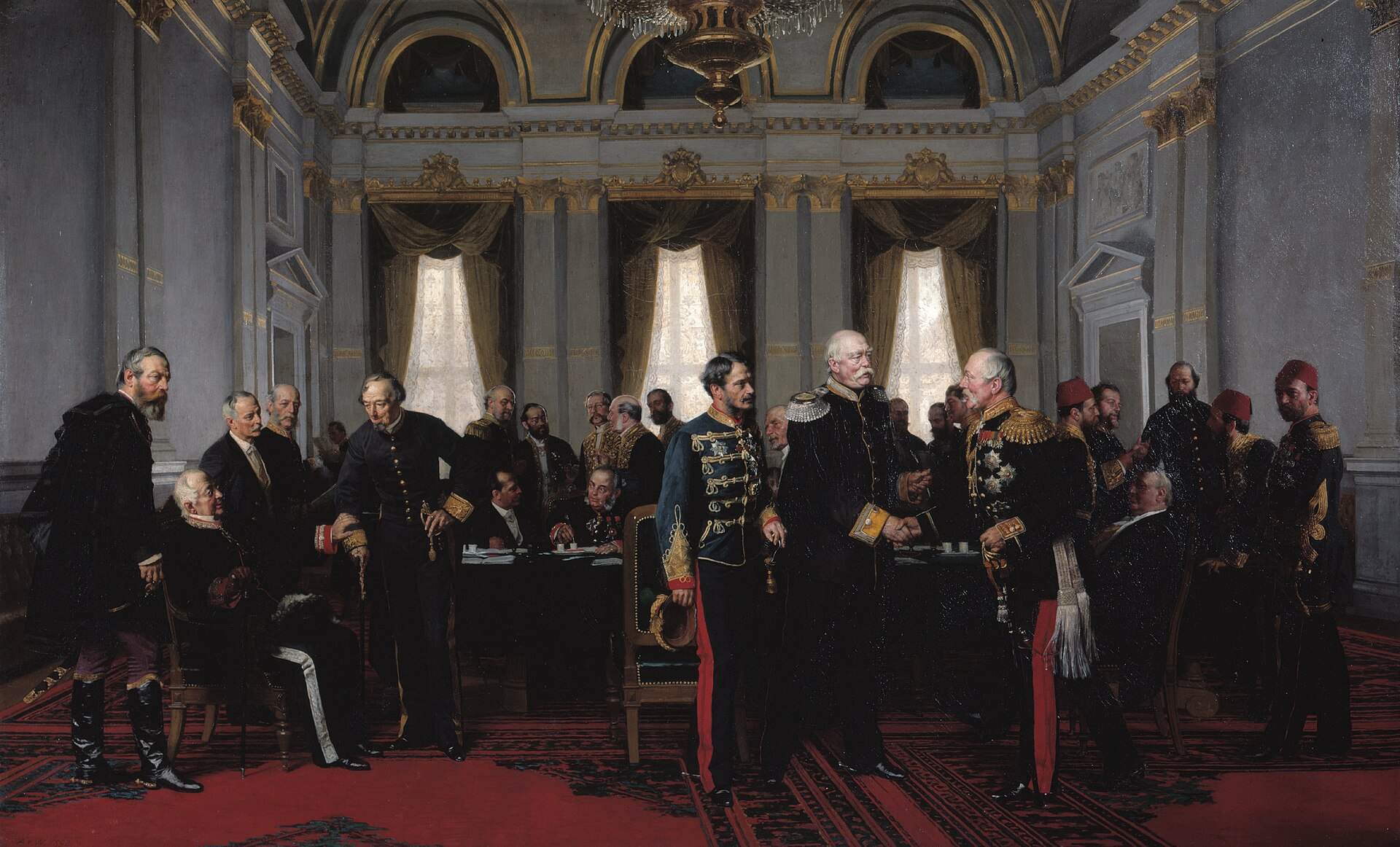
On July 13, 1878, after a month of negotiations held in Berlin, representatives of the seven Great Powers signed the treaty that would reshape the political map of the Balkans. For Germany, Great Britain, Austria-Hungary, Russia, France, Italy, and the Ottoman Empire, the objective was to restore the balance of power in Southeastern Europe after the Russo-Turkish War of 1877–1878. ¹
For the Albanians, however, this was not a peace congress. It was a congress where decisions were made about their lands without their presence.
In the halls of Berlin, borders, territories, and strategic interests were discussed. Peoples were treated as elements of a diplomatic equation, while the Albanians, although they constituted a dense population across a broad ethnic territory, had neither an official delegation nor the right to defend their demands. The memoranda and petitions that Albanian figures sent to European chancelleries remained without influence on the final decision-making process. ²
This exclusion was not merely a formal absence. It reflected the way European diplomacy functioned at the end of the 19th century: the strategic interests of the powers and the balance between them took priority over the national aspirations of peoples who lacked state support. In this sense, the Albanian question was left in the shadows, while territories inhabited by Albanians were included in decisions that favored the territorial expansion of neighboring states or other regional arrangements. ³
The consequences of these decisions cannot be measured only by changes on the map. They affected the lives of thousands of inhabitants of the affected regions, created political uncertainty, encouraged local resistance, and accelerated Albanian national organization. Precisely as a reaction to this reality, the Albanian League of Prizren gained momentum, becoming the most important political organization of Albanians in the 19th century. It did not emerge by chance; it was the response to the belief that, if Albanians did not organize themselves, no one would defend their interests in international diplomacy. ⁴
1. The Congress of Berlin and the Diplomacy of the Great Powers
To understand the importance of the Treaty of Berlin, one must understand the international situation in which it was created.
In the second half of the 19th century, the Ottoman Empire was facing a deep political and military crisis. Its weakening had created a power vacuum in the Balkans, where European powers sought to expand their influence. ⁵
Russia viewed the Balkans as an area of strategic and cultural importance, while Austria-Hungary aimed to prevent Russian expansion and preserve its interests in Southeastern Europe. Great Britain, on the other hand, sought to maintain the European balance and its strategic routes toward the East.
The Russo-Turkish War of 1877–1878 significantly changed the political situation.
After Russia’s victory, the Treaty of San Stefano created a new reality in the Balkans by greatly expanding Russian influence. This development caused concern among the other European powers, which demanded a revision of the agreement. ⁶
Thus, the Congress of Berlin was convened.
However, the main objective of the Great Powers was not the creation of an order based on the will of peoples, but the preservation of a balance between themselves. Within this diplomatic logic, strategic interests were often placed above ethnic realities and the demands of local communities. ⁷
This is precisely one of the main reasons why Albanians experienced the Treaty of Berlin as a historical injustice: they were affected by international decisions, but they did not participate in making them.
2. A People Without a Voice at the Table
Where the Fate of the Balkans Was Decided
In 1878, the Albanians were a people with a distinct linguistic, cultural, and historical identity, but without their own state and without a strong political representation on the international stage.
This was a major weakness at a time when the nations of the Balkans were building their own states and seeking territorial expansion.
Serbia, Montenegro, and Greece already had national projects and territorial ambitions. In this political competition, Albanian lands became a space exposed to various claims. ⁸
For the Albanians, the challenge was not only the preservation of territories. It was also the preservation of identity and the right to be a political factor in the region.
The Treaty of Berlin revealed a harsh reality of the 19th century: a people that lacked political institutions and a diplomatic voice risked having its fate determined by others.
This awareness would become one of the main driving forces behind Albanian national organization.
3. Albanian Lands After Berlin: When Diplomatic Decisions Affected People’s Lives
The Treaty of Berlin did not remain merely a diplomatic document signed by European chancelleries. Its consequences were felt on the ground, in the daily lives of thousands of people who lived in the territories affected by the decisions of the Great Powers.
On the diplomatic maps of the time, territories could be marked with new lines and colors. But behind every changing border line there were villages, towns, families, and communities with long histories. For local inhabitants, a change of administration was not simply a political act; it brought uncertainty regarding property, security, social relations, and their future. ⁹
This was precisely one of the greatest problems of 19th-century diplomacy: decisions were made in the centers of the Great Powers, while the consequences were experienced by local populations.
For the Albanians, this period was accompanied by a sense of the danger of territorial fragmentation. Many of the regions where they lived became the subject of international agreements and the expansionist aims of neighboring states.
Plav and Gusinje: The Clash Between Diplomatic Decisions and the Will of the Inhabitants
One of the most important issues after the Congress of Berlin was that of Plav and Gusinje. According to the decisions made in Berlin, these regions were assigned to Montenegro as part of its territorial expansion. ¹⁰
However, this decision faced strong opposition from the local inhabitants and from the Albanian League of Prizren, which had just begun its political activity.
For the Albanians of Plav and Gusinje, the issue was not only about which administration would govern the territory. It was connected to the continuation of their lives in a space where they had created family, economic, and social ties over generations.
The Albanian League of Prizren viewed this issue as a decisive test. It organized resistance and attempted to show the Great Powers that territorial decisions could not be implemented without taking into account the reality of the local population. ¹¹
The confrontation in Plav and Gusinje was one of the first moments when Albanians appeared as an organized political and military factor.
It demonstrated that the Albanian question could no longer be treated merely as a local issue, but as a matter of importance for the political balance of the Balkans.
Ulcinj: An Albanian City at the Center of International Pressure
After the strong opposition over Plav and Gusinje, the Great Powers sought another solution for Montenegro’s territorial expansion. As compensation, the transfer of Ulcinj under Montenegrin administration was proposed.
This decision also caused major opposition among the Albanians. Ulcinj was not only a strategic point on the Adriatic coast; it was a city with a long Albanian history and with economic, maritime, and cultural importance. ¹²
For European diplomacy, Ulcinj was part of a compromise formula between the powers. For the Albanians, it represented an important center of their national life.
The resistance against the surrender of Ulcinj was another testimony that Albanians were not silently accepting the alteration of their territories.
Nevertheless, international pressure became increasingly strong. In 1880, after numerous clashes and the intervention of the Ottoman Empire against the forces of the Albanian League of Prizren, Ulcinj was handed over to Montenegro. ¹³
This moment remained one of the most painful memories of the post-Berlin period, but at the same time it was also an important point in the formation of Albanian political consciousness.
The Sanjak of Niš: Territorial Changes and Human Consequences
Another important consequence of the developments of 1877–1878 was the transfer of the Sanjak of Niš under Serbian administration.
A considerable Albanian population lived in this area, and it faced major political and social changes. The processes of war and administrative transformation led to the displacement of many Albanian families toward other areas, particularly toward Kosovo. ¹⁴
These population movements left deep marks on Albanian historical memory. For many families, the loss of their settlements meant the loss of their properties, their social networks, and a part of their history.
The displacements of this period show that border changes were not only diplomatic matters. They had direct human consequences.
A Territorial Wound That Turned Into National Awareness
Although the decisions of Berlin brought loss and uncertainty for many Albanians, they also had another important impact: they strengthened the idea of national unity.
The experience of Plav, Gusinje, Ulcinj, and other regions showed that Albanians needed a common political organization.
Local reactions were no longer sufficient; a national platform was required.
This was the reason why the Albanian League of Prizren gained a much greater historical significance than that of a temporary political organization. It became a symbol of the effort to defend national rights at a time when major decisions were being made beyond the voice of the Albanians.
4. The Albanian League of Prizren: From the Defense of Lands to the Idea of the National State
If the Treaty of Berlin was a moment of crisis for the Albanians, the Albanian League of Prizren was the most important political response to this crisis. It emerged from a historical necessity: the need for Albanians no longer to remain merely an object of the decisions of others, but to appear as an organized factor that defended their own interests.
On June 10, 1878, representatives from many Albanian regions gathered in the city of Prizren to create a common political organization. This assembly took place at an extremely sensitive moment: a few weeks after the decisions of the Great Powers to change the map of the Balkans and shortly before the conclusion of the Congress of Berlin. ¹⁵
The creation of the Albanian League of Prizren marked a historic turning point. For the first time, representatives of different Albanian regions attempted to build a common political position on issues that affected their future.
It was not simply an organization aimed at defending certain endangered territories. It marked the beginning of a new concept: Albanians as a national community with common political, cultural, and territorial interests.
From a Reaction to the Crisis to a National Program
At the beginning, the main objective of the League was the defense of Albanian lands within the Ottoman Empire and opposition to decisions that threatened their fragmentation.
But very quickly, its activity expanded. The League began to demand a more suitable administrative organization for Albanian territories, the protection of the Albanian language and Albanian education, as well as the recognition of Albanian national distinctiveness. ¹⁶
This represented a major change in the way Albanians viewed their political future.
For centuries, Albanians had lived within a multinational empire, divided into different administrative units. Religious and regional affiliations had often played an important role in social life.
The League of Prizren introduced a new idea: that above local differences there existed a broader national interest that needed to be defended.
This was a major challenge for the time, because it required the unification of different regions and the creation of a common political consciousness.
Albanian Diplomacy Facing the Great Powers
One of the most important aspects of the activity of the Albanian League of Prizren was its effort to also use the diplomatic path.
The League prepared memoranda and sent delegations to address the Great Powers. These requests emphasized that Albanian territories should not be divided without taking into consideration the will and composition of the local population. ¹⁷
Albanian representatives argued that such a division would create new instability in the Balkans and would violate the rights of a people that possessed a distinct historical and cultural identity.
However, the European diplomacy of the time did not provide the response that the Albanians were seeking. For the Great Powers, the stability created by international agreements and the balance between states was often more important than the demands of peoples who did not have a state.
This disappointment made the League understand that the protection of Albanian interests required not only diplomatic arguments, but also internal organization.
The Confrontation with the Ottoman Empire and the End of the League
One of the greatest paradoxes in the history of the Albanian League of Prizren was the fact that it was initially created to defend Albanian territories within the Ottoman Empire, but later it confronted precisely the Ottoman administration.
In its early stages, some leaders of the League hoped that the Ottoman Empire would accept a form of administrative autonomy for Albanian territories. But as the League grew stronger and its demands became clearer, relations with Istanbul deteriorated. ¹⁸
In 1881, the Ottoman Empire intervened militarily and dissolved the Albanian League of Prizren.
Although the political organization was suppressed, the idea it had created did not disappear. On the contrary, it remained a point of reference for future generations of the Albanian national movement.
The Historical Legacy of the League of Prizren
The importance of the Albanian League of Prizren is not measured only by the years of its existence. It is measured by the influence it had on the formation of Albanian national consciousness.
It demonstrated that Albanians could organize beyond regional and religious divisions and that they could articulate a common political program.
From this perspective, the League was a bridge between the crisis of 1878 and the creation of the Albanian state in 1912.
It was born from a moment of danger, but it transformed into one of the foundations of Albanian political history.
5. From Berlin 1878 to London 1913: The Long Road Toward the Albanian State and the Borders Defined by European Diplomacy
The Treaty of Berlin did not close the Albanian question. On the contrary, it opened a new historical period in which Albanians would face numerous political, diplomatic, and territorial challenges.
The year 1878 revealed the weakness of a people that had a distinct identity but still lacked an organized state capable of defending its interests on the international stage. For this reason, the following decades became a long period of efforts for national awareness, cultural development, and political organization. ¹⁹
After the dissolution of the Albanian League of Prizren, the Albanian national idea did not disappear. On the contrary, it spread through the activities of the National Revival figures, through writings in the Albanian language, efforts to open schools, and through the demand for the recognition of Albanians as a nation with political rights.
During this period, culture became a form of national resistance. The Albanian language, education, and literature were viewed not only as instruments of social development, but also as foundations for preserving identity. ²⁰
The Albanian National Revival: The Construction of a Political Idea
The Albanian National Movement of the late 19th century was not only an effort to defend territories. It was also an effort to build a common national idea.
Albanian Revivalists worked to overcome regional and religious divisions and to create the belief that Albanians, despite their differences, shared a common history, language, and future.
This work was extremely important because, in 19th-century Europe, the idea of the nation was becoming the main foundation upon which new states were being built.
The experience of Berlin had shown that without an articulated political identity, a people risked having no voice in international decisions.
The Balkan Wars and the Return of the Albanian Question to European Diplomacy
At the beginning of the 20th century, the situation in the Balkans became even more unstable. The further weakening of the Ottoman Empire created a new competition among Balkan states for its European territories.
In the years 1912–1913, the Balkan Wars broke out, bringing major political changes to the region. For the Albanians, this was a decisive period: either the Albanian question would find a political solution, or Albanian territories risked being divided among neighboring states. ²¹
In this situation, on November 28, 1912, the Independence of Albania was proclaimed in Vlora. It was a historic act that represented decades of efforts that had begun with the crisis of 1878.
The declaration of independence was not merely a political statement. It was the result of a long historical process in which the experience of Berlin, the activity of the League of Prizren, and the work of the National Revival had played an important role.
The London Conference of 1913: The New State and the Contested Borders
After the declaration of independence, Albania’s fate was once again discussed at European diplomatic tables. The Conference of Ambassadors in London was convened to determine the new political order in the Balkans after the Balkan Wars.
The Great Powers recognized the creation of the Albanian state, but the determination of its borders remained a complicated issue. The decisions made left outside the new state many territories with Albanian populations. ²²
This reality created a sense of historical continuity with the year 1878. In both cases, Albanians faced the fact that the fate of their territories was largely determined by the decisions of international powers.
However, the essential difference was that in 1913 Albanians already had their own state and an internationally recognized political subject.
From a People Without a Voice to a State on the Map of Europe
When viewed from Berlin 1878 to London 1913, this period represents an extraordinary historical journey.
In 1878, Albanians faced the danger of decisions made without their presence. In 1912–1913, they succeeded in creating an independent state, although with borders that remained disputed.
This period demonstrates that the Albanian state was not born from a single event, but from a long historical process built upon sacrifices, political organization, and cultural efforts.
The Treaty of Berlin was one of the most difficult moments of this process, but at the same time it was also one of the factors that accelerated Albanian national awareness.
6. The Legacy of Berlin: Historical Memory, Justice, and the Place of Albanians in Modern Europe
Historical events do not end at the moment when diplomatic documents are signed. Often, their consequences continue to influence the generations that come afterward. For Albanians, the Treaty of Berlin of 1878 is one of those moments that continues to remain present in historical memory, not only because of the decisions that were made at that time, but also because of the impact those decisions had on later political developments in the Balkans.
Berlin was evidence of an era when the destinies of peoples were often determined by the Great Powers, based on strategic interests and international balances. In this process, peoples who lacked a state and strong diplomatic representation were particularly vulnerable. ²³
For Albanians, this period represents a dual historical experience: on one hand, territorial losses and political uncertainty; on the other hand, the birth of a new national consciousness that would change the course of history.
Berlin as a Memory of Historical Injustice and a Political Lesson
The decisions of the Congress of Berlin showed that a political map could change much faster than the lives of the people who inhabited those territories.
For the inhabitants of the Albanian regions affected by these decisions, the new borders were not merely matters of diplomacy. They affected families, economies, social relations, and identities formed over centuries.
Precisely for this reason, Albanian historical memory has preserved the Treaty of Berlin as a symbol of a period when the voice of Albanians was weak on the international stage.
But history should not be viewed only through pain. It should also be viewed through the lessons it leaves behind.
The experience of 1878 showed Albanians that the protection of national interests required organization, education, culture, and diplomacy. From this awareness emerged the Albanian League of Prizren, the National Revival developed, and the path toward independence was prepared.
From a Historical Crisis to the Construction of a State
One of the greatest paradoxes of the history of the Treaty of Berlin is that an agreement experienced by many Albanians as a threat simultaneously became one of the main driving forces of national organization.
The crisis created by territorial decisions produced a political reaction. Albanians understood that without an organized voice, without institutions, and without a national project, their future would remain dependent on the decisions of others.
This process was neither quick nor easy. It required decades of efforts, sacrifices, and work from many political and cultural figures.
From the idea of defending the lands in 1878, the process gradually moved toward the idea of the Albanian state in 1912.
This was one of the most important transformations in modern Albanian history.
A Reflection on the Future
Today, more than a century after the Treaty of Berlin, the memory of this event remains an opportunity to reflect on the importance of historical justice and international responsibility.
The history of the Balkans shows that decisions made without taking into account social realities and the identities of peoples often create consequences that last for generations.
Therefore, the study of Berlin is not only a return to the past. It is also a lesson for the present: lasting peace is built when diplomacy is combined with respect for the rights, dignity, and voice of affected communities.
Conclusion
On July 13, 1878, a treaty was signed in Berlin that changed the political balances of the Balkans. For Albanians, it marked a difficult period, in which many of their territories became part of decisions made by others.
But the history of Albanians after Berlin is not only a history of losses.
It is the history of a people that, from a moment of uncertainty, built a new national consciousness. It is the history of the Albanian League of Prizren, the National Revival, and the long effort that led toward the declaration of independence.
The Treaty of Berlin remains a reminder that borders may be drawn by diplomats and Great Powers, but the identity, memory, and will of a people do not disappear because of a decision made at a diplomatic table.
It remains an important chapter of Albanian history and a testimony that the search for dignity, representation, and historical justice is a process that continues beyond generations.
Footnotes:
1. The text of the Treaty of Berlin (13 July 1878), in the diplomatic documents of the time, including official publications on international relations such as Foreign Relations of the United States, 1878. The document contains the acts of the agreement signed by the Great Powers after the Russo-Turkish War.
2. Memorandum to Lord Beaconsfield (1878), an Albanian diplomatic document addressed to the British government and the Great Powers during the Congress of Berlin, presenting Albanian demands and concerns regarding the protection of their territories.
3. Dëfrim Gashi, “The Congress of Berlin and the Albanian Lands,” Albanological Studies, Albanological Institute of Prishtina, 2014. A study on the impact of the decisions of the Congress of Berlin on Albanian territories and the Albanian national question.
4.Stavro Skendi, The Albanian National Awakening, 1878–1912, Princeton University Press, 1967. A fundamental work on the development of the Albanian National Awakening and the role of the League of Prizren after the crisis of 1878.
5. Nicolae Iorga, Geschichte des Osmanischen Reiches, studies on the crisis of the Ottoman Empire and its influence on Balkan power balances during the 19th century.
6. The Treaty of San Stefano (3 March 1878) and the diplomatic documents related to its revision at the Congress of Berlin. The agreement served as the starting point for the European diplomatic reorganization of 1878.
7. Henry Kissinger, Diplomacy, Simon & Schuster, 1994. Used for the analysis of the concept of the balance of power in European diplomacy.
8. Miranda Vickers, The Albanians: A Modern History, I.B. Tauris, 1995. Addresses the development of the Albanian national question and relations with neighboring states at the end of the 19th century.
9. Noel Malcolm, Kosovo: A Short History, Macmillan, 1998. Analyzes territorial changes, administration, and the social consequences of developments in Albanian territories during this period.
10. The Treaty of Berlin, the article related to the territorial expansion of Montenegro and the issue of the territories assigned after the Russo-Turkish War. The documents of the Congress of Berlin, 1878.
11. Stavro Skendi, The Albanian National Awakening, 1878–1912, Princeton University Press, 1967. A detailed treatment of the role of the League of Prizren in the defense of Plava and Gucia.
12. Kristo Frashëri, The Albanian League of Prizren, Academy of Sciences of Albania. Analyzes the issue of Ulcinj and the political and military efforts of the League.
13. George Gawrych, The Crescent and the Eagle: Ottoman Rule, Islam and the Albanians, 1874–1913, I.B. Tauris, 2006. A description of the relations between the Ottoman Empire, the League of Prizren, and the Ulcinj crisis.
14. Noel Malcolm, Kosovo: A Short History, Macmillan, 1998. A study on demographic changes and the displacement of Albanian populations after the Russo-Ottoman and Serbo-Ottoman wars.
15. Academy of Sciences of Albania, History of the Albanian People, Volume II, Tirana. The chapter on the League of Prizren and the political developments of 1878.
16. Stavro Skendi, The Albanian National Awakening, 1878–1912, Princeton University Press, 1967. An analysis of the transformation of the League from a territorial defense organization into a movement with national demands.
17. Miranda Vickers, The Albanians: A Modern History, I.B. Tauris, 1995. A description of Albanian memoranda and diplomatic efforts addressed to the Great Powers.
18. George Gawrych, The Crescent and the Eagle: Ottoman Rule, Islam and the Albanians, 1874–1913, I.B. Tauris, 2006. A treatment of the relations between the League of Prizren and the Ottoman administration until its suppression in 1881.
19. Stavro Skendi, The Albanian National Awakening, 1878–1912, Princeton University Press, 1967. Discusses the development of the Albanian national movement after the Congress of Berlin and the process of forming national consciousness.
20. Robert Elsie, Historical Dictionary of Albania, Scarecrow Press, 2010. A compilation on the Albanian National Awakening, the development of the Albanian language, education, and national culture.
21. Academy of Sciences of Albania, History of the Albanian People, Volume III, Tirana. A treatment of the Balkan Wars, the declaration of independence, and the political developments of 1912–1913.
22. Margaret MacMillan, The Peacemakers: The Paris Peace Conference of 1919 and Its Attempt to End War, John Murray, 2001 (for the analysis of Great Power diplomacy and the continuity of European diplomatic practices); as well as the documents of the London Ambassadors’ Conference, 1913.
23. Eric Hobsbawm, Nations and Nationalism since 1780: Programme, Myth, Reality, Cambridge University Press, 1990. An analysis of the formation of modern nations and the role of political institutions in the creation of national identities.
The Land of Leka,13.07.2026

 Gazeta britanike: Shqipëria noton në para droge, Rama nuk kërkon falje për rolin e të atit në varjen e Havzi Nelës
 Ndërron jetë Flora Brovina, nesër do të dëshmonte për Masakrën e Dubravës
 “NË KOHËN E BRITMËS” – ROMAN I VISAR ZHITIT. “RILINDJET” E VDEKURA TË SHQIPËRISË DHE PROTESTA… Nga Era Xhaferaj
 Kryeprokurorja e Specializuar shokon nga Haga: Hashim Thaçi përballet me akuza të rënda, do të dënohet gjatë
 PO ADEM JASHARI, A ISHTE UÇK?! Mos ma përmendni LDK-në nëse nuk e kujtoni gjakun e njerëzve që dhanë jetën për të! Nga Fazli Hajdaraj
 Internet i shpejtë për të gjithë, në të gjithë Zvicrën
 Tensione para Dhomave të Specializuara në Hagë- Protestuesit përplasen me policinë holandeze: Largohuni ose do përdorim forcën
 Rrezikojnë dhjetëra vite burgim secili! Shqiptarët në mbështetje të ish-krerëve të UÇK në Hagë: Dënimi i tyre do të ishte vendim politik!
 “Lufta jonë kishte qëllim mbrojtës!” Konjufca para vendimit në Hagë: Presim aktgjykim lirues për Thaçin, Veselin, Selimin dhe Krasniqin
 “Arrestoni Ramën, lironi qytetarët” Protestuesit ‘zbarkojnë’ te Blloku i Sigurisë: Lironi shqipet! Gjithë Shqipëria është me ju
 Sot është dita e vendimit për Hashim Thaçin, Kadri Veselin, Jakup Krasniqin dhe Rexhep Selimin
 Shtatorja e Mbretëreshës Teuta vendoset në Shëngjin, vepra 9 metra e lartë