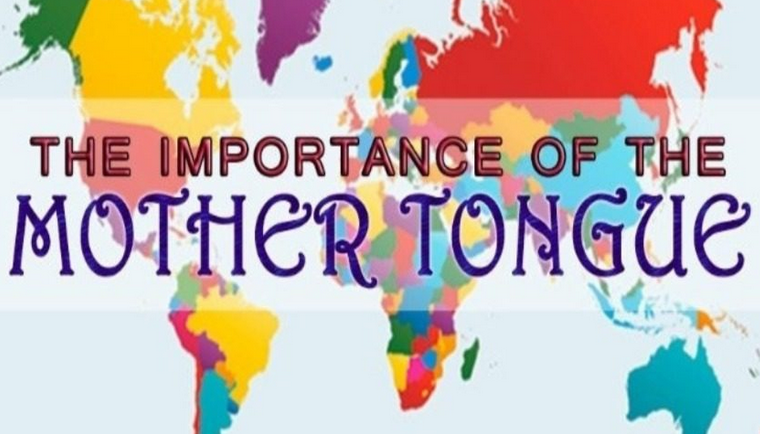
“Equality regarding the right to use one’s mother tongue is not a luxury, but a fundamental and inalienable right directly connected to identity, dignity, and equal opportunities in society.”
Introduction
The right to use one’s mother tongue is a fundamental component of human rights and substantive equality. In higher education, this right guarantees equal participation in the academic process and real opportunities for professional advancement.
In Skopje, Albanian students face persistent obstacles in exercising the right to take exams in the Albanian language, despite this right being constitutionally and legally guaranteed¹. This gap between law and practice undermines the fundamental rights of the Albanian ethnic group, which is autochthonous and co-state-forming, and negatively affects academic advancement.
Historical and Political Context
Before the Ohrid Agreement (2001), autochthonous Albanians faced systematic discrimination in administration and education, and the use of the Albanian language was restricted or prohibited in state institutions². After the Ohrid Agreement, the legal foundations were established for recognizing the Albanian language as an official language at local and administrative levels, including education³. However, implementation in higher education remains fragmented, especially regarding exams in law and practical subjects⁴.
Legal and Constitutional Context
National Constitution
• Articles 7 and 9 of the Constitution guarantee equality and prohibit discrimination on linguistic and ethnic grounds⁵.
• Public institutions, including universities, have a duty to ensure language rights for all citizens⁵.
Law on Higher Education
• Universities must provide fair and non-discriminatory assessment, including the use of the mother tongue⁶.
• Any administrative obstacle preventing the use of Albanian constitutes a legal violation⁶.
Law on the Use of Languages
• The Law on the Use of Languages (2018) strengthens the obligation to use Albanian in state institutions and public education⁷.
• Systematic obstacles in exams constitute a clear legal and constitutional violation⁷.
International Standards
International Covenant on Civil and Political Rights (ICCPR)
Articles 26–27 of the ICCPR guarantee equality and prohibit discrimination on linguistic grounds¹¹. The Human Rights Committee emphasizes the state’s obligation to eliminate all forms of discrimination and ensure practical enforcement¹¹.
Council of Europe
The Framework Convention for the Protection of National Minorities calls for promoting linguistic identity and equal access to education¹². ECHR jurisprudence has established that administrative obstacles to using one’s mother tongue may constitute a violation of human rights¹³.
European Union
The Copenhagen Criteria require respect for the rights of autochthonous ethnic groups and the rule of law¹⁴. The practical non-implementation of these rights poses an obstacle to European integration¹⁴.
Data and Statistics
• Approximately 40% of students at “Mother Teresa” University are Albanian¹⁵.
• Only 30% of exams can be taken in Albanian, mostly in theoretical subjects¹⁵.
• Lack of academic materials and qualified staff increases administrative and academic obstacles¹⁶.
Concrete Examples:
• Albanian students are often forced to take exams in Macedonian, even though the law allows them to choose their mother tongue¹⁶.
• Faculty staff often do not provide consultations in Albanian, hindering exam preparation and academic advancement¹⁶.
Main Issues
1. Systematic non-implementation of exams in Albanian.
2. Indirect discrimination against Albanian students in academic advancement.
3. Contradiction between international declarations and local practice.
4. Lack of monitoring and auditing mechanisms for law enforcement.
Political and International Dimension: Meeting in the USA
• The USA often promotes the rights of autochthonous ethnic groups and the use of the Albanian language in international forums¹³.
• The reality on the ground shows a clear gap between declarations and practice: institutions do not systematically allow exams in Albanian¹³.
• This gap demonstrates a double standard and undermines institutional credibility and international reputation¹³.
Conclusions and Recommendations
Conclusions:
• The right to use the Albanian language is constitutionally and legally guaranteed.
• Non-implementation in practice constitutes a violation of the constitutional order and equality.
• The dualism between international declarations and local practice weakens institutional credibility.
Recommendations:
1. Ensure systematic provision of exams in Albanian.
2. Establish supervisory mechanisms to enforce the law.
3. Involve the USA and international organizations in monitoring the situation.
4. Harmonize practice with European Union and Council of Europe standards.
5. Use the Albanian language as a real example in international forums, not only in diplomatic declarations.
Footnotes:
¹ Ohrid Agreement, “Framework Agreement”, 13 August 2001, published by the OHR Office, Skopje, https://www.ohr.int
² State Archive of North Macedonia, historical documents on language policy before 2001, Government Funds, Skopje
³ Law on the Use of Languages, No. 24/2018, Assembly of North Macedonia, Skopje
⁴ Reports on Albanian students in higher education (2023–2025), “Mother Teresa” University, Skopje (unofficial publication)
⁵ Constitution of North Macedonia, Articles 7 and 9 (1991, with amendments 2001)
⁶ Law on Higher Education, No. 82/2018, Ministry of Education and Science, Skopje
⁷ Law on the Use of Languages, No. 24/2018, Articles 3–5, Assembly of North Macedonia, Skopje
⁸ ICCPR (1966), United Nations Treaty Series; Human Rights Committee, General Comment No. 18 (1989)
⁹ Framework Convention for the Protection of National Minorities, Council of Europe (1995); ECHR, D.H. and Others v. Czech Republic, Application No. 57325/00, 2007
¹⁰ Copenhagen Criteria (1993–1995), official EU documents on enlargement and minority rights
¹¹ “Mother Teresa” University, Annual Report on Albanian Students, 2023, Faculty of Law, Skopje (internal publication)
¹² Interviews with student representatives, Skopje, 2023–2026 (documented by Student Parliament)
¹³ U.S. Department of State, Country Reports on Human Rights Practices: North Macedonia, 2023; Freedom House, Freedom in the World 2023, annual report
¹⁴ European Commission, Enlargement Strategy Reports, 2023
¹⁵ “Mother Teresa” University, Student Demography Report, 2023
¹⁶ Internal survey and interviews with academic staff, 2023–2025
The Land of Leka;06.04.2026
 KARAFILAT QË PËRQAFOJNË “KARIATIDET ”… Kujtime DR. EDUARD A. SKUFI
 Urime për postin e Presidentes, Justinë, çika shtatselvi e Simon Shirokës! Nga Çun Lajçi
 SKIFTER NË SHKREPA- Nga ARIF EJUPI
 KUR RIVALITETI POLITIK I LË VEND INTERESIT TË PËRGJITHSHËM- Nga ARIF EJUPI
 Prokuroria e akuzon Thaçin se ka gënjyer për historinë e UÇK-së – Thaçi duket se u kundërgodit nga intrigat e tij Nga Idriz Morina
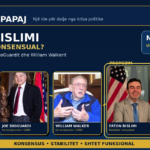 Albin Kurti & opozita duhet të bien dakord për Faton Bislimin, kandidatin për president konsensual propozuar nga kongresmeni JoeDioGuardi & ambasadori Walker Nga Elida Buçpapaj
 Shqipëria në planin rajonal për rikthimin e pyjeve, në fokus Alpet dhe pellgu i Drinit
 Kendi i humorit: I kërkon partnerit të bëjnë përsëri dashuri
 U miratua me 85 vota pro ndarja e re administrative, Shqipëria me 15 bashki më pak, si do funksionojnë! Ekspertët skeptikë: Nuk garanton shërbime për qytetarët
 UGSHPD: TAULANTIT I SHKET GJUHA-Ne jemi palë
 KOSOVA ZGJODHI PRESIDENTEN – TANI DUHET TË ZGJEDHË RRUGËN- Nga Frank Shkreli
 Kosovë, ktheja emrin e vet Kosovës, Dardani- Poezi nga ATDHE GECI