“Serbian World”, Political Networks, and Information Warfare in the Balkans
In recent years, North Macedonia has become one of the most sensitive arenas of political and geostrategic confrontation in the Western Balkans.
While the country remains formally oriented toward Euro-Atlantic integration and is a NATO member, recent political developments indicate that regional influences, particularly those originating from Serbia, are gaining an increasingly visible dimension.[1]
Recent accusations by the Social Democratic Union of Macedonia (SDSM) against VMRO-DPMNE regarding the organization of citizens in support of Serbian President Aleksandar Vučić represent far more than a standard inter-party conflict. At their core, they reflect a struggle over the strategic orientation of the Macedonian state itself: full integration into Euro-Atlantic structures or gradual alignment with the Belgrade–Budapest political axis.[2]
According to the Macedonian opposition, the organization of citizens from North Macedonia to participate in political rallies supporting Vučić demonstrates the existence of a political and ideological influence network established by Serbia in the region.[3] For this reason, SDSM uses the term “Serbian World”, a concept that in recent years has become an important part of political debate in the Balkans.
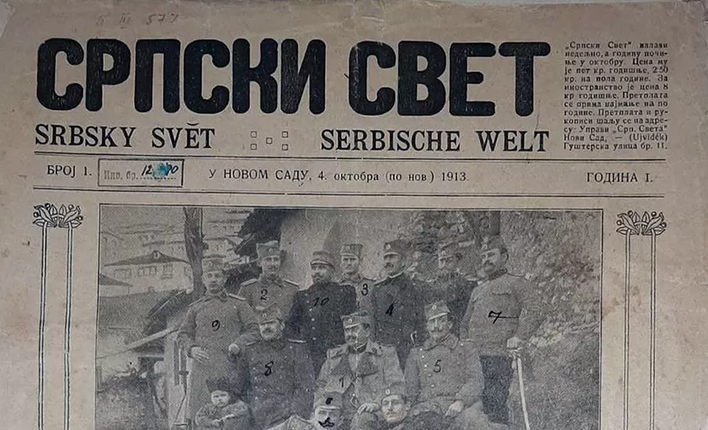
The concept of the “Serbian World” (“Srpski svet”) promotes the idea of political, cultural, and strategic coordination of Serbs in the region under the influence of Belgrade.[4]
Officially, supporters of this concept claim it is aimed at preserving national identity and strengthening cultural cooperation. However, critics argue that it represents a form of expansion of Serbian political influence in neighboring states, using informal mechanisms of political, media, and economic power.[5]
In practice, Serbian influence in North Macedonia does not manifest through classical state intervention, but rather through the gradual construction of influence networks.
These networks operate on several levels:
– through political cooperation with conservative parties and figures;
– through media and information platforms;
– through cultural and civic organizations;
– and through economic and institutional cooperation.[6]
One of the most important instruments of this influence remains the media sphere. Media outlets based in Belgrade have significant penetration in the Western Balkan information space, including North Macedonia.
[7] Through television stations, online portals, and social networks, narratives are disseminated that:
– portray the European Union as weak and unreliable;
– promote skepticism toward the West;
– reinforce nationalist and conservative rhetoric;
– and present Serbia as a regional stability factor.[8]
These narratives have intensified particularly following the stagnation of North Macedonia’s EU integration process.
After the Prespa Agreement and the constitutional name change, citizens were promised a faster opening of EU accession negotiations.[9] However, the Bulgarian veto and political delays in Brussels created deep public frustration and weakened trust in the European project.[10]
In this climate of political frustration, Serbia has managed to position itself as an alternative regional partner, promoting economic and political cooperation through initiatives such as the “Open Balkan” framework.[11]
Critics argue that through such initiatives, Belgrade seeks to establish a dominant role in the Western Balkans and increase the political and economic dependency of smaller states on Serbia.[12]
The other key dimension is information warfare and hybrid influence. Euro-Atlantic institutions have warned that the Western Balkans remain one of the most exposed regions to disinformation and strategic influence operations.[13] In this context, Serbia and Russia are often mentioned as actors sharing common interests in weakening Western influence in the region.[14]
Following Russia’s aggression against Ukraine, information warfare in the Balkans has intensified significantly. Regional media space has seen an increase in:
– anti-NATO narratives;
– messages opposing Western liberalism;
– glorification of authoritarian leadership;
– and propaganda promoting the geopolitical “neutrality” of the Balkans.[15]
In North Macedonia, the opposition claims that some of these narratives are also penetrating political structures close to the current government. In particular, the role of Ivan Stoilković and his ties to political circles in Belgrade are frequently highlighted.[16] For critics, these relations indicate that Serbia is gradually building direct influence over the country’s political life.
Another development that triggered reactions was the participation of Serbian political figures and Republika Srpska leader Milorad Dodik in public events in Skopje.[17] For the Macedonian opposition, these events are not isolated incidents but part of a broader strategy of expanding Serbian political and ideological influence in the region.
Strategically, North Macedonia today stands between two political models:
– the Euro-Atlantic model, based on democratic reforms, European integration, and institutional pluralism;
– and a sovereigntist-conservative model, which promotes political centralization, greater media control, and closer regional ties with Belgrade and Budapest.[18]
For this reason, the debate on the “Serbian World” is not merely a debate about Serbia. It is a debate about the strategic direction of the Western Balkans and the European Union’s ability to maintain its influence in the region.
Footnotes:
[1] European Commission, “North Macedonia Report 2024”, Enlargement Package, Brussels, October 2024.
This annual report evaluates North Macedonia’s progress toward European Union membership. It highlights persistent challenges in judicial independence, public administration efficiency, and political polarization. The report also notes that while the country remains aligned with EU foreign and security policy, domestic instability and regional disputes continue to slow the accession process, contributing to public frustration and reduced trust in the EU integration agenda.
[2] Social Democratic Union of Macedonia (SDSM), Public Statement on Pro-Vučić Rally Organization, May 2026.
The SDSM statement alleges that VMRO-DPMNE-linked structures facilitated or supported the organization of Macedonian citizens to attend political rallies in support of Serbian President Aleksandar Vučić. The statement frames this as evidence of foreign political influence and argues that such actions undermine North Macedonia’s declared Euro-Atlantic orientation and institutional sovereignty.
[3] Regional Media Reports (North Macedonia / Western Balkans), May 2026.
Multiple regional news outlets reported on organized travel and mobilization of citizens from Kumanovo and other cities in North Macedonia to Belgrade in connection with political events supporting Aleksandar Vučić. These reports also referenced the involvement of informal civic groups and networks with ethnic and political ties to Serbian institutions or organizations.
[4] Vuk Vuksanović, “The Serbian World: Political Vision or Regional Strategy?”, LSE IDEAS, London School of Economics, 2022.
This analytical paper examines the emergence of the “Serbian World” concept as a political and ideological framework. It argues that the concept blends cultural nationalism with geopolitical aspirations, aiming to strengthen Serbia’s influence over Serb populations across the Western Balkans through soft power instruments, institutional cooperation, and identity politics rather than territorial expansion.
[5] European Parliament, “Resolution on Foreign Interference and Disinformation in the Western Balkans”, Strasbourg, 2023.
The resolution expresses concern over increasing foreign influence operations in the Western Balkans, particularly involving disinformation campaigns, political networking, and media influence. It identifies Serbia and Russia as key actors in shaping alternative narratives that may undermine democratic institutions, EU integration processes, and regional stability.
[6] Institute for Security Policy, “Serbian Influence Networks in the Balkans”, Belgrade/Brussels, 2024.
This study maps formal and informal Serbian influence structures in the region. It identifies overlapping networks involving political parties, business elites, media organizations, and cultural associations. The report emphasizes that influence is often exerted indirectly through long-standing social, linguistic, and economic ties rather than direct state intervention.
[7] Balkan Investigative Reporting Network (BIRN), “Media Influence and Information Ecosystems in the Western Balkans”, 2024.
BIRN’s research focuses on media ownership structures, cross-border broadcasting, and digital information flows. It concludes that Serbian-based media outlets maintain significant audience penetration in neighboring countries, including North Macedonia, shaping public discourse through entertainment programming, news framing, and politically charged talk shows.
[8] NATO Strategic Communications Centre of Excellence, “Information Operations and Hybrid Threats in the Western Balkans”, Riga, 2023.
This report analyzes hybrid threats including disinformation, cyber influence, and psychological operations. It identifies the Western Balkans as a region vulnerable to external influence due to institutional weaknesses, political fragmentation, and unresolved historical disputes, which can be exploited through coordinated information campaigns.
[9] Prespa Agreement, 17 June 2018.
The Prespa Agreement resolved the long-standing naming dispute between Greece and North Macedonia, enabling the country’s accession to NATO. It also aimed to unlock EU accession negotiations. The agreement is widely regarded as a key geopolitical milestone but has also contributed to internal political divisions and identity-related debates within North Macedonia.
[10] Council of the European Union, Enlargement Conclusions on North Macedonia, 2023–2024.
These conclusions reflect the EU’s ongoing assessment of accession readiness. They highlight the impact of bilateral disputes—particularly with Bulgaria—on the negotiation framework. The documents also emphasize the need for continued reforms in judiciary, public administration, and rule of law as preconditions for further progress.
[11] Regional Cooperation Council, “Open Balkan Initiative Assessment Report”, Sarajevo, 2024.
This report evaluates the “Open Balkan” initiative as a regional economic cooperation framework involving Serbia, North Macedonia, and Albania. While acknowledging potential benefits in trade facilitation and mobility, it also raises concerns about asymmetric influence, with Serbia playing a dominant role in shaping the initiative’s agenda and implementation dynamics.
[12] Florian Bieber, “The Rise of Authoritarianism in the Western Balkans”, Palgrave Macmillan, 2020.
Bieber analyzes democratic backsliding trends in the Western Balkans, focusing on the consolidation of executive power, media capture, and weakening of institutional checks and balances. The book also explores how regional actors promote alternative governance models that challenge liberal democratic norms.
[13] European External Action Service (EEAS), “Foreign Information Manipulation and Interference Threat Report”, Brussels, 2024.
This report outlines EU assessments of foreign information manipulation campaigns targeting European and neighboring regions. It identifies coordinated disinformation efforts using state-linked media, proxy actors, and digital platforms aimed at shaping political attitudes and undermining trust in democratic institutions.
[14] Carnegie Endowment for International Peace, “Russia and Serbia in the Balkans: Strategic Influence and Regional Competition”, Washington DC, 2023.
The study examines the strategic alignment between Russia and Serbia in the Balkans. It highlights shared geopolitical interests, including resistance to NATO expansion narratives and EU normative influence, while noting Serbia’s balancing strategy between East and West.
[15] Center for European Policy Analysis (CEPA), “Strategic Narratives in Southeast Europe”, Washington DC, 2024.
This report analyzes competing geopolitical narratives in Southeast Europe. It identifies the spread of anti-Western rhetoric, nationalist messaging, and authoritarian legitimacy narratives, often disseminated through media ecosystems and political discourse.
[16] Analytical media reports on Ivan Stoilković (2025–2026).
These reports examine the political role of Ivan Stoilković, leader of the Democratic Party of Serbs in North Macedonia and Deputy Prime Minister for Inter-Community Relations. They focus on his political positioning, participation in regional events, and perceived links with political actors in Belgrade, particularly in the context of Serbia–North Macedonia relations.
[17] Regional media coverage of Milorad Dodik’s participation in Skopje events (2026).
Media reports document the participation of Milorad Dodik, President of Republika Srpska, in public and political events in Skopje. His presence has been interpreted by analysts as part of broader regional networking among nationalist and pro-Serbian political actors in the Western Balkans.
[18] Freedom House, “Nations in Transit 2024: Democratic Backsliding in Central Europe and the Balkans”, Washington DC, 2024.
The report assesses democratic governance across the region, documenting trends of institutional weakening, media concentration, and executive dominance. It highlights concerns about democratic backsliding and the influence of non-democratic governance models in parts of Southeast Europe.
The Land of Leka,23.05.2026
 KARAFILAT QË PËRQAFOJNË “KARIATIDET ”… Kujtime DR. EDUARD A. SKUFI
 Urime për postin e Presidentes, Justinë, çika shtatselvi e Simon Shirokës! Nga Çun Lajçi
 SKIFTER NË SHKREPA- Nga ARIF EJUPI
 KUR RIVALITETI POLITIK I LË VEND INTERESIT TË PËRGJITHSHËM- Nga ARIF EJUPI
 Prokuroria e akuzon Thaçin se ka gënjyer për historinë e UÇK-së – Thaçi duket se u kundërgodit nga intrigat e tij Nga Idriz Morina
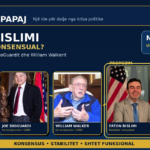 Albin Kurti & opozita duhet të bien dakord për Faton Bislimin, kandidatin për president konsensual propozuar nga kongresmeni JoeDioGuardi & ambasadori Walker Nga Elida Buçpapaj
 Shqipëria në planin rajonal për rikthimin e pyjeve, në fokus Alpet dhe pellgu i Drinit
 Kendi i humorit: I kërkon partnerit të bëjnë përsëri dashuri
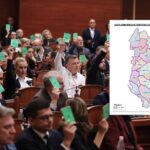 U miratua me 85 vota pro ndarja e re administrative, Shqipëria me 15 bashki më pak, si do funksionojnë! Ekspertët skeptikë: Nuk garanton shërbime për qytetarët
 UGSHPD: TAULANTIT I SHKET GJUHA-Ne jemi palë
 KOSOVA ZGJODHI PRESIDENTEN – TANI DUHET TË ZGJEDHË RRUGËN- Nga Frank Shkreli
 Kosovë, ktheja emrin e vet Kosovës, Dardani- Poezi nga ATDHE GECI