I. The Unbroken Thread: From Partia e Punës to Partia Socialiste
Any honest assessment of Albania’s present must acknowledge a reality that Western diplomacy has often downplayed: the Socialist Party of Albania (Partia Socialiste, PS) is not a clean break from the communist era. It is the direct institutional successor to Enver Hoxha’s Party of Labor (Partia e Punës e Shqipërisë), the vehicle of total state control for 46 years. The party was not dissolved or rebuilt from scratch; it rebranded from within, preserving its organizational networks, regional power bases, and, in many cases, its key familial and patronage structures.
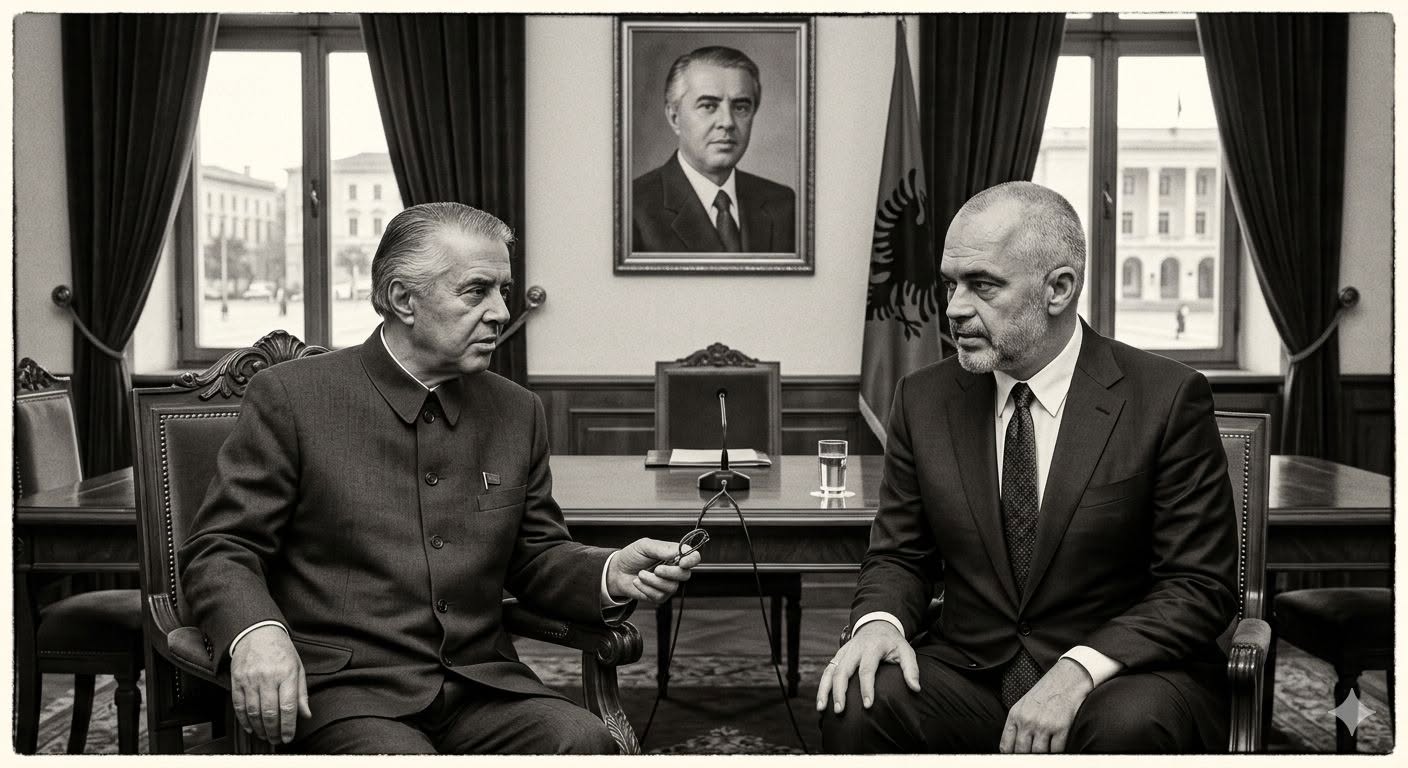
Edi Rama has led the party since 2005 and served as Prime Minister since 2013. His father, Kristaq Rama, was a prominent sculptor of regime monuments, a member of the People’s Assembly, and—most significantly—a member of the Presidium that reviewed and ratified death sentences under the communist system. Among those executed was the poet and dissident Havzi Nela, hanged in 1988 for “anti-state agitation” after Kristaq Rama participated in the body that approved the warrant.
This is not an argument of inherited guilt. It is a recognition of institutional continuity and the persistent absence of meaningful accountability—factors that profoundly shape the character of the contemporary Albanian state.
II. The Failure of Lustration: A Documented Record
U.S. government reporting has long highlighted Albania’s incomplete reckoning with its communist past. The State Department’s 1997 Human Rights Report documented how lustration laws—intended to bar former senior communist officials and Sigurimi collaborators from public office—were rapidly diluted. Amendments in a single year progressively narrowed their scope, ultimately barring no candidates from the elections.
Albania remains one of the few post-communist Eastern European states without a credible, comprehensive lustration process. As a result, there has been no full decommunization of institutions, public administration, or the judiciary.eafff5
The 2021 State Department Human Rights Report noted ongoing petitions from former political prisoners for compensation, with little government progress. Unresolved cases of missing persons from the communist era also persist. This unprocessed legacy forms the foundation of today’s political landscape: a society that absorbed rather than confronted its past.
III. The Structure of Power: Continuity by Other Means
The critique that Rama’s governance exhibits elements of authoritarian continuity is not mere opposition rhetoric. It is visible in structural patterns.
Clientelism modernized: The Hoxha-era party-state operated through loyalty-based distribution of resources. Under Rama, this model has been updated via large-scale infrastructure spending. During Deputy Prime Minister Belinda Balluku’s tenure, her ministry directed nearly €3.8 billion in infrastructure projects (2024–2026), which Rama touted as a signature achievement. Subsequent SPAK investigations alleged manipulation of tenders and diversion of public funds in connection with these initiatives.
The SPAK test: The Special Anti-Corruption and Organized Crime Structure (SPAK), created under strong EU pressure, represents the most serious post-communist institutional reform. Its actions against high-level figures— including the arrest of Tirana Mayor Erion Veliaj (seen as a potential successor to Rama) and proceedings against Balluku—challenged the longstanding assumption of elite immunity.
The government’s response has been mixed: public endorsement of SPAK alongside criticism of its “overreach,” verbal attacks on prosecutors, and parliamentary resistance. In March 2026, the Socialist-dominated parliament voted (82 against) to block SPAK’s request to arrest former Deputy Prime Minister Balluku, shielding a senior official and precipitating a major crisis between political power and the very justice reforms the government had championed.
Rama has simultaneously praised SPAK as a reform success and warned of its “collateral damage.” This duality exemplifies captured reform: institutions built to meet external expectations but restrained when they encroach on core interests.
IV. The EU Accession Paradox
Albania’s EU path reveals a tension Brussels has been reluctant to confront head-on. Procedurally, progress is tangible. By late 2025, Albania had opened all negotiating clusters, including advancements in justice reform and anti-corruption efforts. In May 2026, it met interim benchmarks for Cluster 1
The judicial vetting process has yielded results: by early 2026, roughly 66% of judges and prosecutors were reviewed, with many removed for unexplained wealth, criminal ties, or incompetence.
Yet structural weaknesses remain. Transparency International and other monitors have highlighted ongoing political pressure on judicial institutions, particularly in high-profile corruption cases involving ruling-party figures. The EU Delegation responded pointedly to the Balluku parliamentary vote, stressing that a credible environment for SPAK is “essential” for accession progress.
The core paradox persists: procedural compliance and selective institutional strengthening coexist with incomplete democratic transformation, allowing continuities of power to endure.
V. What Albania Must Do: A Reform Architecture for Genuine Integration
Sustainable Western integration requires more than technical benchmarks. It demands political will and moral clarity. Key prerequisites include:
Comprehensive lustration: Fully open the Authority for Information on Former State Security (AIDSSH) files to the public, researchers, and victims’ families. A binding accounting of the Hoxha-era apparatus—executions, informants, and Presidium roles—is essential for legitimacy. Other successful Central and Eastern European transitions (Poland, Czech Republic, Baltics) demonstrate its necessity.
Insulate SPAK constitutionally: Remove parliamentary immunity votes as a blocking mechanism in SPAK cases, aligning with Chapter 23 requirements. The European Commission should treat this as a firm condition, not a suggestion.
Address media capture: Depoliticize the Audiovisual Media Authority (AMA) and enforce genuine pluralism. Party-aligned outlets attacking judicial bodies must face regulatory accountability, with international oversight tied to negotiation progress.
Complete restitution and compensation: Fulfill long-delayed obligations to former political prisoners and their families, as repeatedly noted in U.S. State Department reports. This is both a human rights imperative and a test of historical honesty.
U.S. policy recalibration: Tie security and economic partnerships to verifiable rule-of-law benchmarks. Consistent transatlantic conditionality would close the space for playing Washington against Brussels.
VI. Conclusion: The Test Is Transformative, Not Procedural
Albania is not a failed state. Its EU accession momentum, judicial vetting outcomes, and SPAK’s demonstrated reach mark real departures from past impunity. These achievements deserve recognition.
Yet genuine membership in the Western community of values transcends checklists. It requires accountable power, independent institutions, and an honest confrontation with the past.
Thirty-five years after the Hoxha regime’s collapse, its institutional successor still governs. Victims’ families await full justice, secret police files remain incompletely disclosed, and parliament voted in 2026 to protect its own from accountability mechanisms created partly for external consumption.
The Albanian diaspora’s protests reflect a deeper demand: a state that truly belongs to its citizens, not to the political lineage that has dominated it across regimes for most of a century.
Sources: U.S. Department of State Country Reports on Human Rights Practices (Albania, various years including 1997 and 2021); European Commission Albania Progress Reports (2025); European Council Accession Conference outcomes (2025–2026); Transparency International reporting; analyses from OSW Centre for Eastern Studies, BIRN, Tirana Times, European Western Balkans, and official SP.
The views are personal and not of the US State Department where the author works.
 “Thaçi dhe Veseli e morën me pranga” Gjykata e Hagës për zhdukjen e Behajdin Allaqit 28 vite më parë: Jemi të bindur se ai u vra, në komunikatë thanë se ra dëshmor
 Ndërron jetë Flora Brovina, nesër do të dëshmonte për Masakrën e Dubravës
 Disa sugjerime për leximin e aktgjykimit ndaj katër ish-drejtuesve të lartë të UÇK-së Nga Veton Surroi
 HOROSKOPI I JAVËS 14-20 SHTATOR 2026
 Kërcënohet me vdekje gazetari Osman Stafa- Asociacioni i Gazetarëve të Shqipërisë: Policia e Shtetit të hetojë rastin me urgjencë
 SHBA-ja: Respektojmë aktgjykimin ndaj ish-krerëve të UÇK-së
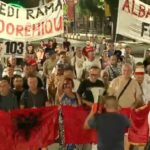 113 ditë protesta- Televizioni australian pasqyron revoltën e shqiptarëve kundër Ramës: Kërkohet dorëheqja e kryeministrit
 Ukraina godet Moskën në ditën e fundit të zgjedhjeve parlamentare në Rusi
 KRYEMINISTRAT VIJNË DHE SHKOJNË, KOMUNITETI MBETET Nga Valentin Lumaj
 Disa sugjerime për konstatim të përbashkët të gjendjes pas Aktgjykimit të 16 shtatorit- Nga VETON SURROI
 Revolucioni Flamingo në Bienalen Ndërkombëtare të Roterdamit
 The Scotsman (1976) “Një çarje në perden e Shqipërisë” — Britanikja Christine Phillips në Shqipërinë e izoluar të Enver Hoxhës