Albanian Student Association of Fordham University in New York event marks the English edition of The Jahelez of Dragobia
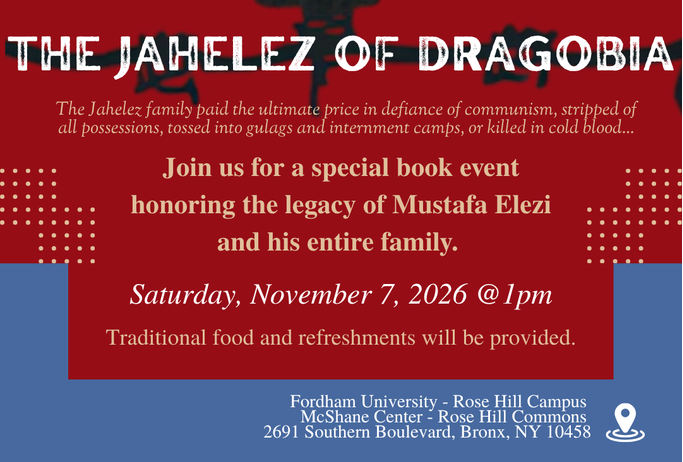
NEW YORK, Nov. 7, 2026. On Saturday afternoon, in a quiet room at Fordham University, the translator Lekë Buçaj walked a copy of a newly published book across the floor and placed it in the hands of Mergim Elezi. The book is the English edition of The Jahelez of Dragobia, the memoir of Mergim’s father, Mustaf Elezi. Buçaj said the gesture fulfilled an amanet, a sacred trust passed from one person to another, which he had carried for years.
The moment was the emotional center of an event organized by Fordham’s University Albanian Student Association (ASA) to examine the book and the history behind it. Association co-president Leona Gjevukaj opened the program with a greeting in Albanian, “Mirë se keni ardhur,” and told the audience the afternoon was meant to explore how communism shaped Albanian lives and families across generations. For students growing up between cultures, she said, such conversations help “preserve stories that deserve to be heard.” She thanked the association’s executive board and everyone who helped organize the event.
Gjevukaj then introduced the guest speaker, Dr. Mithat Gashi, as an Albanian American educator and community advocate whose work has connected education, scholarship, and service. She noted that he has served as principal of New World High School in the Bronx and has taught in Lehman College’s Department of Middle and High School Education. Gashi earned his doctorate at Fordham, she added, and brings a perspective as both an educator and an active member of the Albanian American community.
Gashi outlined the program and led the audience in standing for the national anthems of Albania and the United States. In his talk, “Preserving the Truth: The Jahelez of Dragobia and Historical Memory,” he described Dragobia, a mountain valley in northern Albania near the borders with Kosova and Montenegro, and the family memoir by Ndue Ukcama that follows the Jahelez over sixty-four years, from November 1944 to 2008. Mustaf Elezi arrived in the Bronx in 1968, Gashi noted, and lived there longer than anywhere else.
He also reminded the room that Fordham has long been part of the Albanian community, with many events held in its halls. He recalled meeting Ibrahim Rugova, the Kosova intellectual who later became its president, at Fordham in 1989, when Rugova came to speak at an event marking the 300th anniversary of Pjetër Bogdani.
Gashi, who escaped Albania in 1986, said the history is not distant for him. He pointed to the 1988 hanging of the poet Havzi Nela as a sign of how recent these events are. He asked the audience to consider what the regime tried to take from the family: their land, their contact with one another, their name, and their story. Had Mustaf Elezi not put his memoir on paper, Gashi said, these stories would have vanished.
“Who will tell the story?”
To make the point about memory and preservation, Gashi told a story from about fifteen years ago, when he worked with the photographer Norman Gershman, who documented how Albanians rescued Jews during World War II. The two visited the Kupferberg Holocaust Center at Queensborough Community College together. When Gashi asked how the center raised its funds, the answer from the director of the center was a line posted at the entrance, asking who will tell the story when they are all gone. Gashi lingered on this moment, and it shaped the rest of his remarks.
A promise passed between friends
Buçaj then explained how the book came into English. Mustaf Elezi, he said, had told his friend Zef Përndocaj that he wanted the story translated. Përndocaj raised it with Dr. Gjon Buçaj, Lekë’s father. Elezi died on October 1, 2018. After his death, Dr. Buçaj asked his son to take on the work.
Lekë had spent years as a translator and interpreter for federal government agencies, but he was busy, and the book was long. He accepted anyway. Dr. Buçaj died in 2022, and Lekë said the project then became something he was bound to finish, an amanet. He thanked his mother, Nikoleta, who sat in the audience, for always speaking to him in Albanian as he grew up. Without that, he suggested, he could not have done the work.
Then he called Mergim Elezi forward, handed him a copy of the book, and said that this fulfilled the amanet.
Family members also spoke. Among them were Mustaf Elezi’s eldest son, Mergim, and his daughter Sanije, who shared personal stories about her father’s first trip back to Albania. Sanije’s daughter, Syzana Vuçetaj, who holds a Ph.D. from New York University, also addressed the audience. Elezi’s other daughter, Shpresa, shared her emotions and memories in conversation following the program.
Voices from the page
Students and family members read from the book between remarks. Gjevukaj read the account of Mustaf Elezi’s arrest in August 1949. Ema Alikçaj, also a co-president of the association, gave her part of the reading of “February 19, 1957: Farewell!”, about his flight from Albania, to Mustaf Elezi’s granddaughters Tabitha and Victoria and their mother, Mergim’s wife. Art Lacaj read “The Night of August 30, 1960,” and its aftermath, when fifteen families were interned. Andrra Kryeziu closed the readings with the family’s request from the epilogue: “Please, no longer say, ‘Oh, how the Jahelez have suffered,’ but ‘Oh, how they resisted.’”
Gashi then invited Prof. Kadri Brogi of Hunter College, CUNY, to offer reflections. Brogi encouraged the young people in the room to seek out activities like this one and to stay close to their history.
He also spoke about the falsification of history under communism. Schools taught that 28000 deshmorë, or martyrs, fell during World War II among the 27 brigades, he said, a claim he called a lie that makes no statistical sense. He added that every brigade commander was later executed or killed during the long years of the dictatorship. Gashi added that this included Mehmet Shehu, commander of the First Brigade, who later became prime minister and died in 1981 in circumstances the regime described as suicide.
A panel discussion followed among students, Brogi, and Gashi.
In closing, Gashi returned to the question from the Holocaust center and turned it into a call to action. He urged the students to ask questions at their own family tables, to write down what their parents and grandparents tell them before it is lost, and to read stories like this one aloud. Memory survives, he said, only when someone picks it up. The afternoon ended with questions from the audience, followed by refreshments and conversation.
The English edition of The Jahelez of Dragobia is available on Amazon.com.

 Keda Kaceli: Iu luta Papa Leo XIV të bekojë rininë shqiptare kundër kesaj të keqeje antishqiptare që ka zaptuar jetën e bashkëkombësave tanë! Intervistoi Elida Buçpapaj
 Gazetari i huaj zbulon ku fshihet Rama gjatë protestave rinore: Në një vilë të kuqe betoni me shumë roje
 “Të ndihen të llastuar si në hotel”- Zbulohen kërkesat e pazakonta të Ballukut për vilën në Palasë: Nga pishina infinity te vaskat me hidromasazh si në Santorini
 Sa shumë PS kemi brenda PD…. Nga Adriatik Riza Dosti
 FADIL BERISHA NDEROHET NË VATIKAN – Nga Frank Shkreli
 HOROSKOPI I JAVËS 9-15 NËNTOR 2026
 Skandali në Nvidia, bordi përgatitet të shkarkojë CEO-n, Jensen Huang
 Pasoi Vlora Hysenin, kush është Esmeralda Hasani, drejtuesja e re e SHISH?
 Quo vadis revolucion?- Nga Lutfi Dervishi
 Sulm izraelit ndaj spitalit Nasser në Gaza, 6 të vrarë dhe mbi 20 të plagosur, mes viktimave edhe një kirurg
 Skenari i ekspertëve të Pentagonit: Putini vdes në janar 2027, Rusia nis luftë me NATO-n në vitin 2030
 Shpërthen makina-bombë në Shën Petersburg, vritet koloneli rus