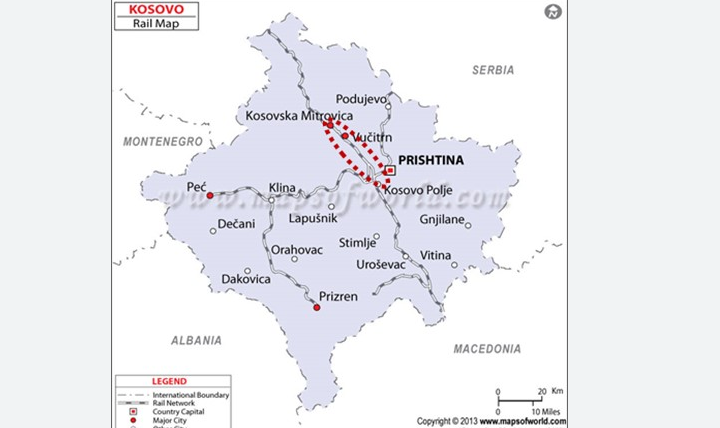
Kosovo authorities on Thursday carried out an institutional operation in the north of the country, assuming administrative control over railway stations in Serb-majority municipalities and placing them under the management of the public railway infrastructure company Infrakos. The operation took place in the early morning hours in Zvečan and, according to government officials, also includes several other railway stations in northern Kosovo.[1]
Present at the scene were acting Minister of Internal Affairs Xhelal Sveçla, acting Minister of Economy Artane Rizvanolli, and acting Minister of Infrastructure Dimal Basha. During the operation, authorities removed a sign written in the Cyrillic alphabet from the railway station building and raised the flag of Kosovo on the facility, symbolizing the transfer of institutional control from Serbian-run structures to Kosovo institutions.[2]
Minister Dimal Basha stated that the railway stations in northern Kosovo had until now operated under what the Government of Kosovo considers parallel Serbian structures functioning outside Kosovo’s legal framework. According to him, Infrakos will assume full management of four railway stations in the north as part of a broader process of institutional integration of public infrastructure across the entire territory of Kosovo.[3]
Minister Artane Rizvanolli likewise stated that Kosovo’s public enterprises are gradually extending their operations into the northern municipalities by taking control of public assets that for years had functioned outside the administration of Pristina. She described the assumption of control over the railway stations as another step toward consolidating Kosovo’s institutional sovereignty in the north.[4]
At the time of the intervention, according to media reports from the scene, one worker was present inside the station building. Following the arrival of Kosovo Police officers and government officials, he reportedly collected his personal belongings and left the premises without incident. No tensions or confrontations have been reported thus far.[5]
The development is viewed as part of a broader series of actions undertaken in recent months by Kosovo authorities in the north of the country, where institutions have assumed control over facilities and enterprises that previously operated within the Serbian system. As part of the ongoing crisis in northern Kosovo, authorities have also intervened in sectors including water utilities, municipal administration, and other public enterprises.[6]
The issue of railway control in northern Kosovo has long represented a sensitive point in relations between Kosovo and Serbia. For years, railway segments north of Mitrovica were reportedly managed by Serbian-operated structures rather than Kosovo institutions, despite the infrastructure being formally regarded as part of Kosovo’s railway network.[7]
Historically, control over railway lines in northern Kosovo has been the subject of political and security tensions since the period following Kosovo’s declaration of independence. In 2008, the United Nations mission in Kosovo intervened to restore control over a railway segment in the north after Serbia attempted to assume management of part of the line near Zvečan.[8]
Kosovo’s railway network comprises hundreds of kilometers of active railway lines and forms part of a regional transport corridor linking the Western Balkans with the broader European railway system. Modernization projects for Kosovo’s rail infrastructure have been supported by the European Union and international financial institutions, with particular attention given to the Mitrovica–Leshak railway segment extending toward the Serbian border.[9]
Thursday’s operation comes at a politically sensitive moment, coinciding with the official opening of the electoral campaign for Kosovo’s June 7 elections. Political analysts view the development as part of the Kosovo Government’s broader strategy to demonstrate effective institutional control in the north, an area that for years has remained one of the principal points of dispute between Pristina and Belgrade.
Footnotes
[1] Media reports on the takeover of railway stations in northern Kosovo, published on 28 May 2026.
[2] Local media reports and footage from the scene documenting the removal of the Cyrillic sign and the raising of the Kosovo flag at the railway station in Zvečan, 28 May 2026.
[3] Statement by acting Minister of Infrastructure Dimal Basha to the media during the operation in Zvečan, confirming that Infrakos would assume management of four railway stations in northern Kosovo.
[4] Statement by acting Minister of Economy Artane Rizvanolli regarding the extension of Kosovo public enterprises into northern municipalities and the assumption of control over public assets, 28 May 2026.
[5] Journalistic reports from the scene describing the peaceful departure of a station worker following the arrival of Kosovo Police and government officials.
[6] See reports and analyses concerning institutional developments in northern Kosovo during 2024–2026, including interventions involving municipal administration, water utilities, and public enterprises.
[7] KoSSev, “Kosovskim železnicama na severu upravlja Srbija” [“Serbia Manages Railways in Northern Kosovo”], report concerning the administration of railway infrastructure in northern Kosovo.
[8] Reuters, “UN versus Serbia in Kosovo railway shunting match,” 4 March 2008, reporting on tensions surrounding railway control in northern Kosovo following Kosovo’s declaration of independence.
[9] Hill International, “The Express Train to Europe: Rehabilitating Kosovo’s Railway Route 10,” report on railway modernization projects in Kosovo and the strategic importance of the Mitrovica–Leshak railway corridor.
The Land of Leka,28.05.2026
 KARAFILAT QË PËRQAFOJNË “KARIATIDET ”… Kujtime DR. EDUARD A. SKUFI
 Urime për postin e Presidentes, Justinë, çika shtatselvi e Simon Shirokës! Nga Çun Lajçi
 SKIFTER NË SHKREPA- Nga ARIF EJUPI
 KUR RIVALITETI POLITIK I LË VEND INTERESIT TË PËRGJITHSHËM- Nga ARIF EJUPI
 Prokuroria e akuzon Thaçin se ka gënjyer për historinë e UÇK-së – Thaçi duket se u kundërgodit nga intrigat e tij Nga Idriz Morina
 Albin Kurti & opozita duhet të bien dakord për Faton Bislimin, kandidatin për president konsensual propozuar nga kongresmeni JoeDioGuardi & ambasadori Walker Nga Elida Buçpapaj
 Shqipëria në planin rajonal për rikthimin e pyjeve, në fokus Alpet dhe pellgu i Drinit
 Kendi i humorit: I kërkon partnerit të bëjnë përsëri dashuri
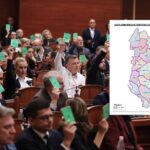 U miratua me 85 vota pro ndarja e re administrative, Shqipëria me 15 bashki më pak, si do funksionojnë! Ekspertët skeptikë: Nuk garanton shërbime për qytetarët
 UGSHPD: TAULANTIT I SHKET GJUHA-Ne jemi palë
 KOSOVA ZGJODHI PRESIDENTEN – TANI DUHET TË ZGJEDHË RRUGËN- Nga Frank Shkreli
 Kosovë, ktheja emrin e vet Kosovës, Dardani- Poezi nga ATDHE GECI