Through an interdisciplinary approach combining diplomatic history and classical international law, it argues that although the treaty constituted a formally valid legal act under nineteenth-century international practice, it produced profoundly destabilizing consequences for the territorial continuity of Albanian-inhabited regions and for the consolidation of Albanian national subjectivity.
Keywords: Eastern Question, classical international law, cession of territory, self-determination, League of Prizren.
I. The European Legal Order and the Eastern Question By the late nineteenth century, the European legal order was structured around the system of the “Concert of Europe,” consolidated by the Congress of Vienna (1815) and partially reaffirmed by the Treaty of Paris (1856). This system upheld the balance of power and the territorial integrity of the Ottoman Empire, yet it did not recognize the principle of nationality as a binding legal norm. Subjects of international law were exclusively sovereign states; stateless peoples such as the Albanians lacked international legal personality.[1] Consequently, decisions concerning territories inhabited by Albanians were taken without their participation or consent.
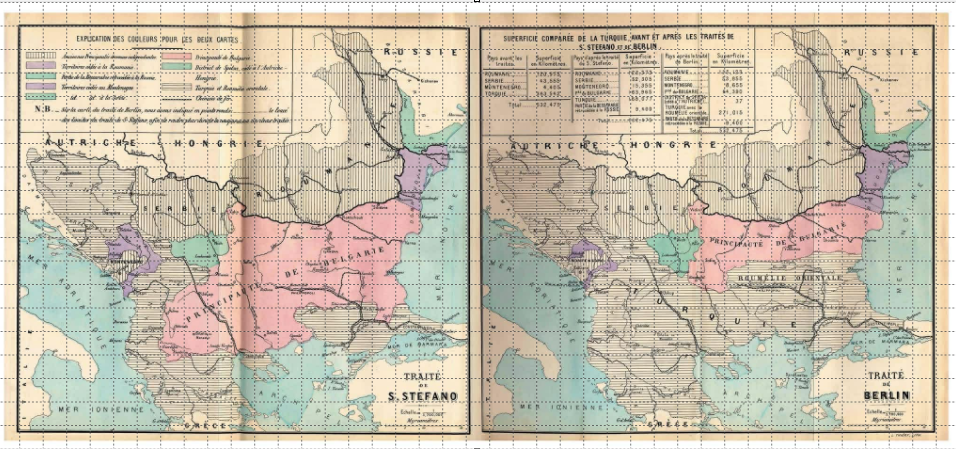
II. The Legal Nature of the Treaty of San Stefano The treaty was concluded between the Russian Empire and the Ottoman Empire as a bilateral agreement without multilateral consultation. It was legally valid inter partes, yet it entailed far-reaching territorial consequences.
Under classical international law:
• Territorial transfer (cessio territorii) entailed full transfer of sovereignty;
• The population of transferred territories passed under the jurisdiction of the acquiring state;
• No referendum or popular consultation was required.[2]
Although the principle pacta tertiis nec nocent nec prosunt was recognized doctrinally, it was often subordinated in practice to great-power politics within the framework of the Eastern Question.[3]
III. Territorial Fragmentation of Albanian-Inhabited Lands
The treaty provided for:
• The creation of a Greater Bulgaria under Russian influence;
• Territorial expansion of Kingdom of Serbia;
• The tripling of the territory of the Principality of Montenegro.
These provisions affected regions with substantial Albanian populations in Kosovo, Macedonia, and northern Albania.
The resulting fragmentation:
1. Disrupted ethno-geographical continuity;
2. Weakened traditional economic networks;
3. Created enduring grounds for interethnic conflict.
IV. Demographic and Civil Legal Consequences
The practical implementation of territorial transfers was accompanied by:
• Mass displacement of Albanians (muhajirs);
• Confiscation of property;
• Alteration of the legal status and nationality of the population.
Classical international law lacked comprehensive mechanisms for the protection of ethnic minorities.
Although the Congress of Berlin (1878) introduced certain guarantees for religious minorities, it did not establish a general regime for ethnic minority protection applicable to Albanians.[4]
Thus, Albanians in the transferred territories remained without effective international legal safeguards.
V. Crisis of Legitimacy and the Emergence of Albanian Political Subjectivity
The Treaty of San Stefano exposed the structural limitations of nineteenth-century international law for stateless peoples. In the absence of international legal remedies, Albanians responded through internal political organization.
The establishment of the League of Prizren (June 1878) marked a decisive turning point.
It represented:
• An attempt to unify Albanian-inhabited vilayets into a single autonomous administrative unit within the Ottoman Empire;
• A political articulation of collective territorial defense;
• An embryonic step toward statehood.
This transformation marked the shift from imperial subjecthood to nascent national political agency.
VI. Retrospective Analysis in Light of Modern International Law The principle of self-determination of peoples, clearly articulated after 1918 and codified in the UN Charter (1945), did not exist as positive law in 1878.[5]
Nevertheless, from a modern legal perspective:
• Territorial partition without popular consent contradicts the principle of self-determination;
• Forced displacement would today violate international humanitarian law;
• The absence of minority protections would be considered a serious normative deficiency.
Conclusion
The Treaty of San Stefano was formally valid under classical international law.
However, it had profound consequences for the Albanians:
• Territorial fragmentation;
• Demographic upheaval;
• Loss of property rights;
• Marginalization within the European diplomatic system.
Paradoxically, the treaty accelerated the consolidation of Albanian national consciousness and contributed to the emergence of a political project culminating in independence in 1912.
In this sense, the Treaty of San Stefano represents a foundational moment in the transformation of Albanians from objects of great-power diplomacy into subjects of international law.
Footnotes
[1] Emer de Vattel, The Law of Nations (1758); Henry Wheaton, Elements of International Law, 8th ed., 1866. [2] Lassa Oppenheim, International Law: A Treatise, Vol. I, 1905. [3] Ian Brownlie, Principles of Public International Law, 7th ed., 2008. [4] Barbara Jelavich, History of the Balkans, Vol. I–II, Cambridge University Press, 1983. [5] Antony Anghie, Imperialism, Sovereignty and the Making of International Law, Cambridge University Press, 2005.
The Land of Leka;03.03.2026

 KARAFILAT QË PËRQAFOJNË “KARIATIDET ”… Kujtime DR. EDUARD A. SKUFI
 Urime për postin e Presidentes, Justinë, çika shtatselvi e Simon Shirokës! Nga Çun Lajçi
 SKIFTER NË SHKREPA- Nga ARIF EJUPI
 KUR RIVALITETI POLITIK I LË VEND INTERESIT TË PËRGJITHSHËM- Nga ARIF EJUPI
 Prokuroria e akuzon Thaçin se ka gënjyer për historinë e UÇK-së – Thaçi duket se u kundërgodit nga intrigat e tij Nga Idriz Morina
 Albin Kurti & opozita duhet të bien dakord për Faton Bislimin, kandidatin për president konsensual propozuar nga kongresmeni JoeDioGuardi & ambasadori Walker Nga Elida Buçpapaj
 BIRN: Shqipëria, e papërgatitur për një ndryshim të rregullave të lojës nga BE
 Lisat nuk ikën- Poezi të reja nga Ismet TAHIRAJ
 Kamberi i përgjigjet Vuçiqit: “Nuk kuptoj çfarë po të shqetëson nga angazhimi im për shqiptarët”
 Shqipëria në planin rajonal për rikthimin e pyjeve, në fokus Alpet dhe pellgu i Drinit
 Kendi i humorit: I kërkon partnerit të bëjnë përsëri dashuri
 U miratua me 85 vota pro ndarja e re administrative, Shqipëria me 15 bashki më pak, si do funksionojnë! Ekspertët skeptikë: Nuk garanton shërbime për qytetarët