While international attention often focuses on the war in Ukraine and global tensions, the Western Balkans remain a highly sensitive strategic and legal zone. Statements by Serbian President Aleksandar Vučić near military bases along the Kosovo border, coupled with reports of hundreds of Serbian citizens fighting in Ukraine under the Russian banner, are not mere political gestures—they represent a destabilizing strategy with direct implications for Kosovo’s sovereignty and regional security.
This writing analyzes the risks, legal implications, and international frameworks relevant to Kosovo, as well as situations in other sensitive areas such as North Macedonia, the Presevo Valley, and Sandzak, while offering recommendations for alternative problem solving.
Vučić’s Implications and Serbo-Russian Influence
Vučić’s public statements and military symbolism serve several strategic purposes:
1. Consolidating a nationalist political base within Serbia and mobilizing public opinion around the idea of “recovering lost territories.”
2. Sending threatening signals to non-Serbian communities and Kosovo authorities, creating pressure on international actors.
3. Normalizing the idea of future territorial conflict, violating the principles of the UN Charter, Article 2(4), which prohibits the use of force against the territorial integrity of states [1].
From a legal perspective, these actions intersect with several key international instruments:
• The Hague Conventions (1907) and the Geneva Conventions (1949, Additional Protocols I & II), governing conduct in armed conflicts and civilian protection [2].
• Article 51 of the UN Charter, outlining the right to self-defense [3].
• The Vienna Convention on Diplomatic Relations (1961), prohibiting external interference in domestic affairs of states [4].
Situational Analysis in the Wider Region
1. Presevo Valley (Southern Serbia)
The Presevo Valley, predominantly Albanian, remains vulnerable to Serbian destabilizing narratives and Russian influence:
• Pressure on Albanian communities increases the risk of ethnic tensions and discriminatory policies.
• Violations of human and minority rights, as enshrined in the International Covenant on Civil and Political Rights (ICCPR), reinforce narratives of international neglect [5].
• Threats against Kosovo’s territorial integrity escalate regional security risks.
2. North Macedonia
• Serbian influence over local Serbian communities and political actors could affect inter-ethnic relations.
• External pressures may challenge the principle of non-intervention and regional stability, undermining agreements such as the Prespa Agreement (2018), which normalized relations with Greece and supported EU/NATO integration [6].
3. Sandzak (Serbia and Montenegro)
• Sandzak, with significant Bosniak and Albanian populations, is susceptible to nationalist rhetoric and paramilitary influence from Belgrade.
• Returning fighters under Russian influence could pose risks to local law and order, violating the Geneva Conventions and International Humanitarian Law [7].
Concrete Risks for Kosovo and the Region
1. Destabilization of northern Kosovo and neighboring regions: Returning fighters may integrate into paramilitary networks, violating Kosovo’s Criminal Code and International Humanitarian Law [8].
2. Diplomatic and legal pressure on the West: Coordinated narratives portraying Kosovo as a disputed entity may challenge international recognition and the principle of non-intervention [9].
3. Normalization of conflict ideology and ethnic tensions: Vučić’s rhetoric may influence Serbian and Albanian communities in the region, contravening Geneva Conventions and minority rights protections [10].
4. Use of Russia as a strategic shield: Moscow strengthens Belgrade’s aggressive stances and undermines regional stability, violating UN resolutions [11].
Recommendations for the West and KFOR
1. Continuous monitoring by KFOR, EULEX, and Western embassies of early indicators of destabilization in Kosovo and surrounding areas [12].
2. Strengthening preventive presence in northern Kosovo, the Presevo Valley, and Sandzak.
3. Coordinated diplomatic dialogue with Belgrade and Skopje to ensure compliance with international law and protect minority communities.
4. Accurate and coordinated counter-disinformation targeting destabilizing narratives.
5. Emergency response planning in coordination with NATO HQ and rapid reaction forces.
6. Support for local institutions to strengthen rule of law and integrate minority communities, in line with international human rights conventions [13].
Conclusion
The Western Balkans cannot be ignored. Destabilizing narratives, Vučić’s political symbolism, and Russian influence are not merely political challenges—they are real threats to regional stability and the international order. Kosovo and neighboring regions have demonstrated reliability as partners for peace and the rule of law. However, without coordinated action, continuous monitoring, and strong counter-narratives, the risk of escalation cannot be underestimated. Proactive measures are essential for the security of the entire Western Balkans.
Legal Footnotes and International References
[1]: Article 2(4), UN Charter – prohibition of use of force.
[2]: Geneva Conventions, 1949; Additional Protocols I & II.
[3]: Article 51, UN Charter – right of self-defense.
[4]: Vienna Convention on Diplomatic Relations, 1961.
[5]: ICCPR – International Covenant on Civil and Political Rights.
[6]: Prespa Agreement, 2018.
[7]: International Humanitarian Law and Geneva Conventions on paramilitary activity.
[8]: Kosovo Criminal Code and International Humanitarian Law.
[9]: Advisory Opinion, ICJ, 2010, on the Unilateral Declaration of Independence of Kosovo.
[10]: International Convention on the Protection of the Rights of National Minorities, 1992.
[11]: UN resolutions on international peace and security.
[12]: EULEX Kosovo, Security Assessment Reports, 2024–2025.
[13]: ICCPR and ICESCR – International Covenant on Economic, Social, and Cultural Rights.
The Land of Leka; 15.12.2025
 KARAFILAT QË PËRQAFOJNË “KARIATIDET ”… Kujtime DR. EDUARD A. SKUFI
 Urime për postin e Presidentes, Justinë, çika shtatselvi e Simon Shirokës! Nga Çun Lajçi
 SKIFTER NË SHKREPA- Nga ARIF EJUPI
 KUR RIVALITETI POLITIK I LË VEND INTERESIT TË PËRGJITHSHËM- Nga ARIF EJUPI
 Prokuroria e akuzon Thaçin se ka gënjyer për historinë e UÇK-së – Thaçi duket se u kundërgodit nga intrigat e tij Nga Idriz Morina
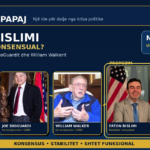 Albin Kurti & opozita duhet të bien dakord për Faton Bislimin, kandidatin për president konsensual propozuar nga kongresmeni JoeDioGuardi & ambasadori Walker Nga Elida Buçpapaj
 Jared Kushner për investimet në Shqipëri- Nga KASTRIOT HAXHIAJ
 Kemi njerëzit e politikës, të cilët nuk janë pasuruar më punë, dhe shumicën që po mbijetojnë. Nuk është çudi që të rinjtë po ikin- Nga Skënder MULLIQI
 Nobeli për Paqe i ndahet gjyqtares afrikanojugore Navi Pillay
 BIRN: Shqipëria, e papërgatitur për një ndryshim të rregullave të lojës nga BE
 Lisat nuk ikën- Poezi të reja nga Ismet TAHIRAJ
 Kamberi i përgjigjet Vuçiqit: “Nuk kuptoj çfarë po të shqetëson nga angazhimi im për shqiptarët”